
Why Does It Always Come Down to the Bathroom?
Understanding the peculiarities of Parisian period apartments
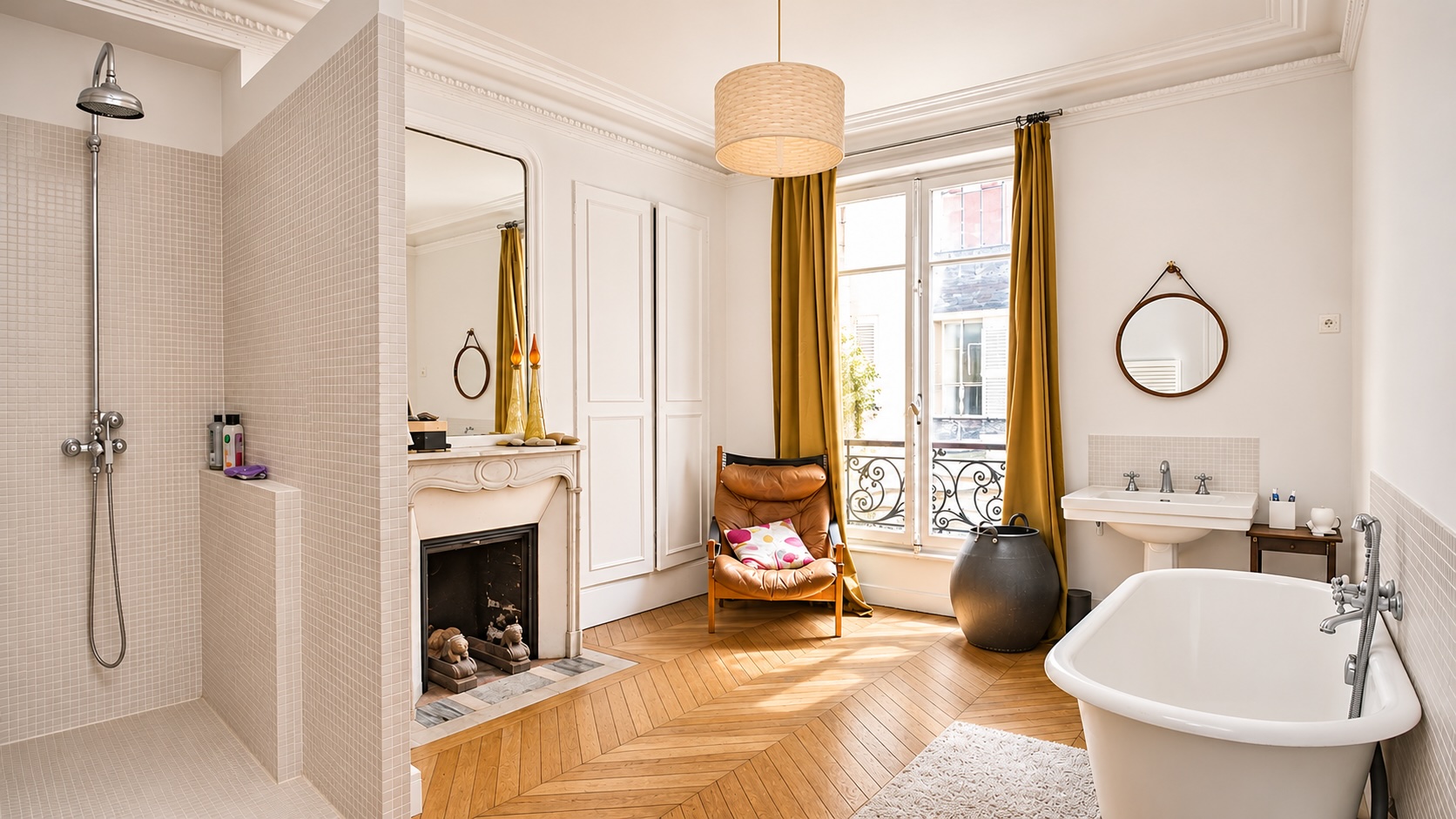
The location is perfect. The building is magnificent. The apartment has soaring ceilings, beautiful parquet floors, original marble fireplaces and tall French windows opening onto a quintessentially Parisian street.
Our clients are falling in love.
And then we reach the bathroom.
Perhaps there is only one for three bedrooms. Perhaps the toilet is at the other end of the apartment. Or perhaps, in an otherwise remarkably generous 150-square-meter (1,615 sq. ft.) apartment, there is barely enough space for a double vanity.
Why does it always come down to the bathroom?
As with so many peculiarities of Parisian real estate, the answer lies in the city's history.
When Architectural Luxury Meant Something Different
Many of Paris's most desirable buildings were constructed at a time when domestic comfort was defined very differently from today.
From the elegant hôtels particuliers of the 17th and 18th centuries to the magnificent Haussmannian buildings of the 19th century, the architects who shaped Paris devoted considerable attention to reception rooms, proportions, natural light and decorative detail.
The organization of an apartment reflected a particular social hierarchy. Receiving guests, entertaining and displaying one's social standing were central to its design. Private and functional spaces, on the other hand, were generally given considerably less architectural importance.
And this was particularly true of bathrooms.
Modern standards of domestic sanitation were still developing, and what we consider indispensable today was once a considerable luxury.
Even in elegant bourgeois apartments, personal washing often took place in a cabinet de toilette, a small private space adjoining the bedroom. While sometimes exquisitely decorated, it might contain little more than a marble-topped washstand, a porcelain basin, a water pitcher and a bidet.
The presence of a fireplace in every principal room was once a more significant indication of standing than the presence of a fully equipped bathroom.
When Parisians Bathed Outside Their Homes
Paris has a long tradition of public bathing establishments, some of which were surprisingly luxurious.
However, as the city expanded during the 19th century, improving access to personal hygiene became an important public health concern.
From the late 19th century onwards, Paris developed a network of municipal bains-douches, offering affordable washing facilities to residents whose homes lacked them.
For many Parisians, a regular visit to the neighborhood bathing establishment, often as part of a weekly routine, complemented daily washing at home.
It is rather fascinating to imagine that, while some of the city's most beautiful architectural achievements were relatively recent, many of their contemporaries still did not have a private bathroom.
The widespread arrival of running water, modern plumbing and domestic water heating gradually transformed everyday life. Yet it took much of the 20th century for private bathrooms to become the norm across all social classes.
Interestingly, some of Paris's municipal bains-douches remain in operation today, continuing to fulfill an important social function while bearing witness to this chapter of the city's history.


Historic Parisian bathhouses "Bains-douches", traditional bathing rituals and contemporary bathroom elegance.
Adapting Yesterday's Architecture to Today's Lifestyle
As domestic expectations evolved, Parisian period apartments were gradually modernized to accommodate bathrooms, showers and indoor toilets.
But these facilities had to be integrated into buildings that had not necessarily been designed to accommodate them.
Former dressing rooms, storage areas and sections of corridors were converted into bathrooms. In some apartments, space was taken from bedrooms or adjoining rooms.
The location of these new facilities was often dictated less by architectural logic than by the availability of water supply and drainage.
Successive generations of owners adapted their apartments according to their needs, tastes and the technical possibilities of their time.
This explains why two seemingly identical apartments in the same Parisian building may have surprisingly different floor plans today.
What we discover during a property viewing is often not simply the architect's original design, but the accumulated decisions of several generations of Parisians.
Why Adding a Bathroom Is Not Always That Simple
One of the most frequently asked questions during our property searches is whether a second bathroom can be added.
Sometimes, the answer is surprisingly straightforward. On other occasions, it is considerably more complicated.
Unlike a cupboard or a partition wall, a bathroom cannot simply be placed wherever there is sufficient floor space.
Several technical considerations come into play:
* Drainage: Wastewater pipes need an adequate diameter and slope to function properly.
* Toilets: Installing or relocating a WC can be particularly challenging if the appropriate drainage stack is too far away.
* Ventilation: Bathrooms without windows require an appropriate means of extracting humidity.
* Building structure: Historic floors, beams and load-bearing walls may limit the possibilities for installing new pipes.
* Co-ownership regulations: Work affecting common pipes, structural elements or other shared parts of the building may require approval from the co-ownership.
Occasionally, adding a bathroom involves raising part of the floor to accommodate drainage pipes, introducing a step that one would ideally prefer to avoid.
The availability of space is therefore only one part of the equation. What lies beneath the beautiful parquet floors or behind the centuries-old walls can be equally important.
The Curious Case of the Sanibroyeur
One particularly ingenious response to the limitations of historic buildings is the sanibroyeur, or macerating toilet, which occasionally surprises our international clients during property viewings.
Unlike a conventional toilet, which relies on gravity and a relatively large drainage pipe, a sanibroyeur uses an electrically powered mechanism to break down waste and pump it away through a smaller pipe.
It has made it possible to install toilets in locations where conventional plumbing would have been difficult or even impossible – from former servants' quarters to additional bathrooms in otherwise prestigious apartments.
Ingenious as it may be, however, the system is not without its drawbacks. It can be noisy, depends on electricity, requires more careful use and may be more prone to mechanical problems than a conventional toilet.
Its installation is also subject to regulations and, in Paris, requires prior approval from the building's co-ownership.
When purchasing an apartment equipped with a sanibroyeur, it is therefore worth establishing whether the installation was duly authorized and whether replacing it with a conventional toilet would be technically feasible.
The presence of a sanibroyeur is not necessarily a reason to dismiss an otherwise attractive property, particularly when it serves as an additional rather than the apartment's only toilet.
It is, once again, a reminder of the sometimes inventive ways in which Paris has adapted its architectural heritage to modern standards of comfort.
A Question of Different Cultural Expectations
Our international clientele brings another interesting dimension to the subject.
Many North American buyers, in particular, are accustomed to homes where the number of bathrooms is almost as important as the number of bedrooms. An en-suite primary bathroom, a double vanity and a separate guest powder room may form an integral part of their wish list.
Traditional Parisian apartments follow a different logic.
A generous family apartment with three bedrooms and just one bathroom is not necessarily considered unusual. A separate WC, sometimes without a washbasin, is another feature that can surprise international buyers.
Even today, many French buyers appreciate having the toilet separate from the bathroom, particularly when several people share the same home.
Neither approach is inherently better. They simply reflect different domestic habits and architectural traditions.
Nevertheless, these differences can become a significant consideration when purchasing a property in Paris.
The Art of Finding the Right Compromise
Should you give up on an otherwise exceptional apartment because it lacks a second bathroom?
Not necessarily.
We have seen beautifully reconfigured Parisian apartments where thoughtful architectural interventions have created additional bathrooms without compromising the property's original character.
We have also seen renovations where the desire to maximize the number of bathrooms came at the expense of bedroom proportions, natural light or the architectural harmony that made the apartment so attractive in the first place.
The challenge is to distinguish between what can be changed, what cannot, and what perhaps should not be changed.
This is why, as part of our property search services, we look beyond its existing presentation. Where necessary, we draw on the expertise of architects and contractors to assess the feasibility of adapting an apartment before our clients commit to purchasing it.
An outdated bathroom may be relatively easy to transform. Creating an entirely new one is a different undertaking.
If you are considering purchasing a period apartment in Paris and wondering how it might accommodate your lifestyle, we would be delighted to discuss your project with you.
Understanding that distinction can make all the difference.
Living in a City That Was Not Built for Us
Part of the extraordinary appeal of Paris is that so much of its architectural heritage has survived.
We fall in love with apartments conceived for another century, another society and another way of life. We admire their generous reception rooms, their intricate moldings, their historic fireplaces and their wonderfully imperfect parquet floors.
Yet we expect them to accommodate the comforts and conveniences of the 21st century.
Reconciling these two worlds is not always easy, but it is part of what makes finding and owning a Parisian period apartment so interesting.
And perhaps the next time we stand in an exquisite Haussmannian apartment wondering why on earth there is only one bathroom, we will look at it a little differently.
After all, the architect who gave us those magnificent proportions was designing for a very different way of life.
It is rather fortunate that he got so much else right.
Of Note: An interesting regulatory update: According to the City of Paris, whose guidance was updated on April 20, 2026, authorization from the municipal authorities is no longer required to install a sanibroyeur. However, prior authorization from the co-ownership at its general assembly remains necessary. This is worth knowing for our own professional practice, too.