
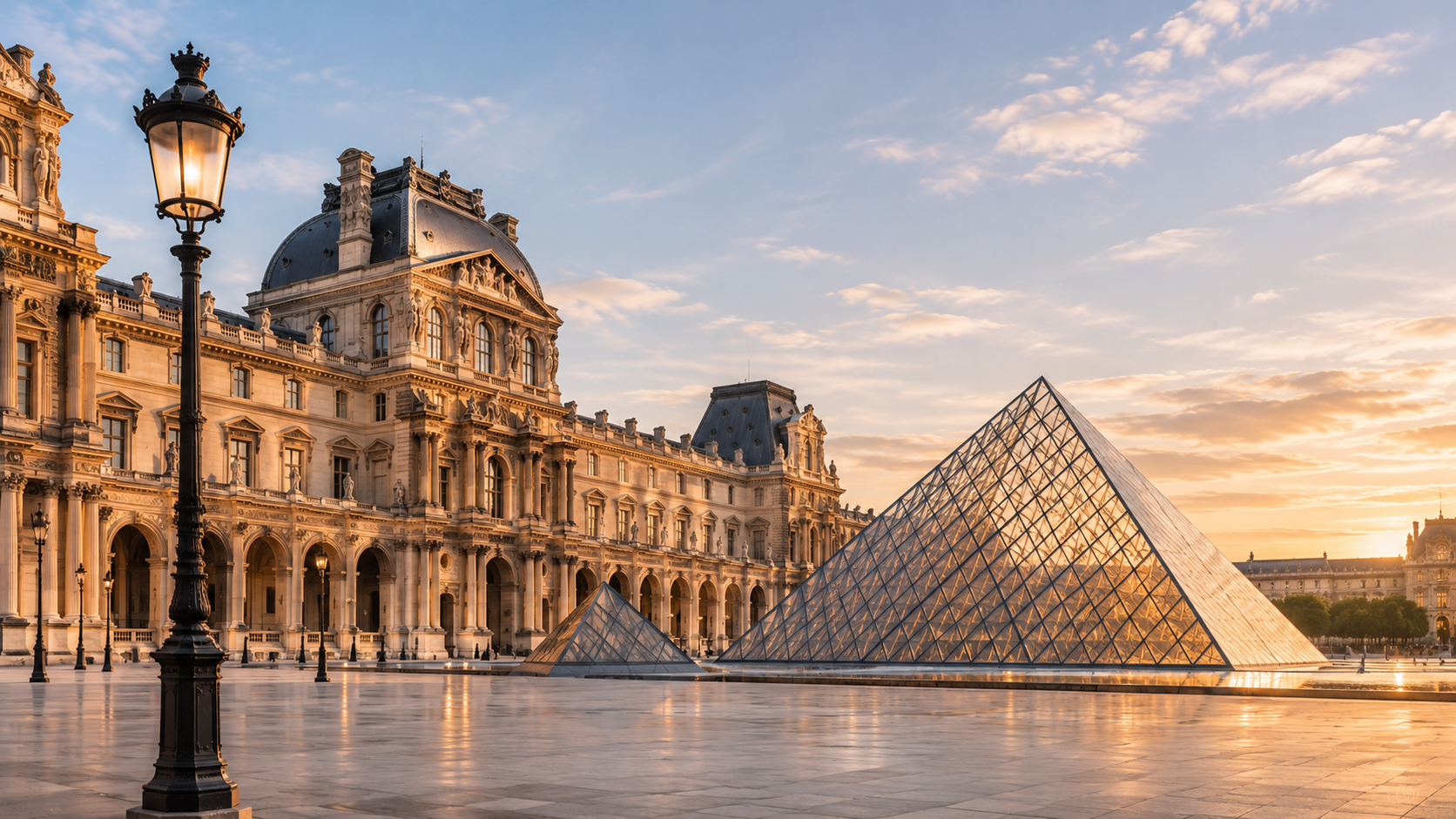
From the Renaissance façades of the Louvre to the elegant Haussmannian boulevards and intricate Art Nouveau Métro entrances, Paris owes much of its distinctive character to generations of visionary architects.
Few cities bring together so many centuries of architectural history so harmoniously.
For those looking to make Paris their home, understanding this heritage can also provide a fascinating insight into the city’s neighborhoods, buildings and apartments.
The Louvre: From Pierre Lescot to I. M. Pei
The Louvre is perhaps one of the most striking examples of Paris’s architectural evolution.
In the 16th century, Pierre Lescot helped transform the former medieval fortress into a Renaissance palace. A century later, Louis Le Vau contributed to its expansion under Louis XIV.
Generations of architects continued to reshape the complex before I. M. Pei introduced his now-iconic glass pyramid in 1989.
Initially controversial, the pyramid has since become one of the capital’s most recognizable landmarks. Much like the Eiffel Tower a century earlier, it is a reminder that even the most familiar symbols of Paris were once daring architectural innovations.
Charles Garnier and the Paris Opéra
Inaugurated in 1875, the Palais Garnier is one of the finest expressions of the architectural ambition of 19th-century Paris.
Its architect, Charles Garnier, was still in his thirties when he won the competition to design the new opera house.
With its monumental staircase, elaborate sculptures, marble and gilded interiors, the building is a celebration of the decorative arts.
Standing at the end of avenue de l’Opéra, it is also inseparable from the great urban transformation taking place in Paris at the time.
Haussmann and the Transformation of Paris
Although not an architect himself, Baron Georges-Eugène Haussmann arguably had more influence on the appearance of modern Paris than any individual architect.
Appointed prefect of the Seine by Napoleon III in 1853, he oversaw an ambitious urban redevelopment that introduced wide boulevards, public gardens and modern infrastructure.
The elegant limestone façades, wrought-iron balconies and characteristic zinc rooftops associated with Paris today emerged from this transformation.
Inside, high ceilings, decorative moldings, parquet floors and marble fireplaces continue to make Haussmannian apartments particularly sought after by our international buyers.
Yet the success of Haussmann’s vision extends beyond individual buildings. It also lies in the relationship between architecture, streets and public spaces.
Hector Guimard: Art Nouveau in Everyday Paris
At the turn of the 20th century, Hector Guimard introduced an entirely different architectural language to the capital.
His famous Métro entrances, with their distinctive green ironwork and organic forms inspired by nature, remain among the most recognizable examples of Parisian Art Nouveau.
One of the finest surviving examples is the glass-roofed Métro entrance at Porte Dauphine.
Guimard also designed residential buildings, notably the Castel Béranger, completed in 1898 in the 16th arrondissement.
With its imaginative decorative details and unconventional forms, this remarkable building illustrates how architectural innovation made its way into everyday Parisian life.
Jean Nouvel: Contemporary Architecture in Paris
Paris continues to reinvent itself while preserving its remarkable architectural heritage.
Among the architects contributing to this evolution is Jean Nouvel, whose Institut du Monde Arabe opened in 1987 on the banks of the Seine.
Its distinctive southern façade features geometric screens inspired by traditional Arab architecture, designed to regulate the light entering the building.
Nouvel’s other notable Parisian projects include the Philharmonie de Paris at La Villette and the new Fondation Cartier, which opened in 2025 near the Palais-Royal.
The latter is a particularly interesting example of contemporary architecture integrated into a historic Parisian building.
Finding Your Own Piece of Parisian Architectural Heritage
One of the pleasures of searching for an apartment in Paris is discovering the diversity of its residential architecture.
From the exposed beams of a centuries-old building in the Marais to the generous proportions of a Haussmannian apartment or the distinctive features of an Art Nouveau building, each period offers something different.
Beyond aesthetics, these architectural differences also influence floor plans, natural light, ceiling heights and the way an apartment lends itself to contemporary living.
At 56Paris Real Estate, understanding these characteristics is an integral part of helping our clients find a home that reflects their lifestyle, priorities and appreciation of Paris.
If you are considering buying a property in Paris, we would be delighted to guide you through the city's remarkable architectural and real estate landscape.