
The Galerie d’Apollon Reopens: What Paris Values Beyond Price
Between the spectacular Louvre jewel heist and the recent burglary at the Plaza Athénée, Paris has provided some rather embarrassing headlines lately.
Beyond the inevitable questions about security, there is something almost unsettling about both stories. They expose a collision between two very different ways of looking at beauty and luxury: as something with history, craftsmanship and cultural meaning — or simply as something with a price tag.
Perhaps France, a country where heritage is so deeply woven into everyday life, has occasionally been a little too trusting of the first interpretation.
The Louvre robbery was a particularly brutal reminder.
On 19 October 2025, thieves broke into the Galerie d’Apollon and targeted two high-security display cases containing jewels from the French royal collections. Eight 19th-century pieces were stolen, including the diadem of Empress Eugénie and jewels associated with Marie-Amélie, Hortense and Marie-Louise.
The theft was shocking not simply because of the material value involved — estimated at some €88 million — but because these were objects whose significance cannot meaningfully be expressed by their market value alone.
And yet the story has produced an unexpected consequence.
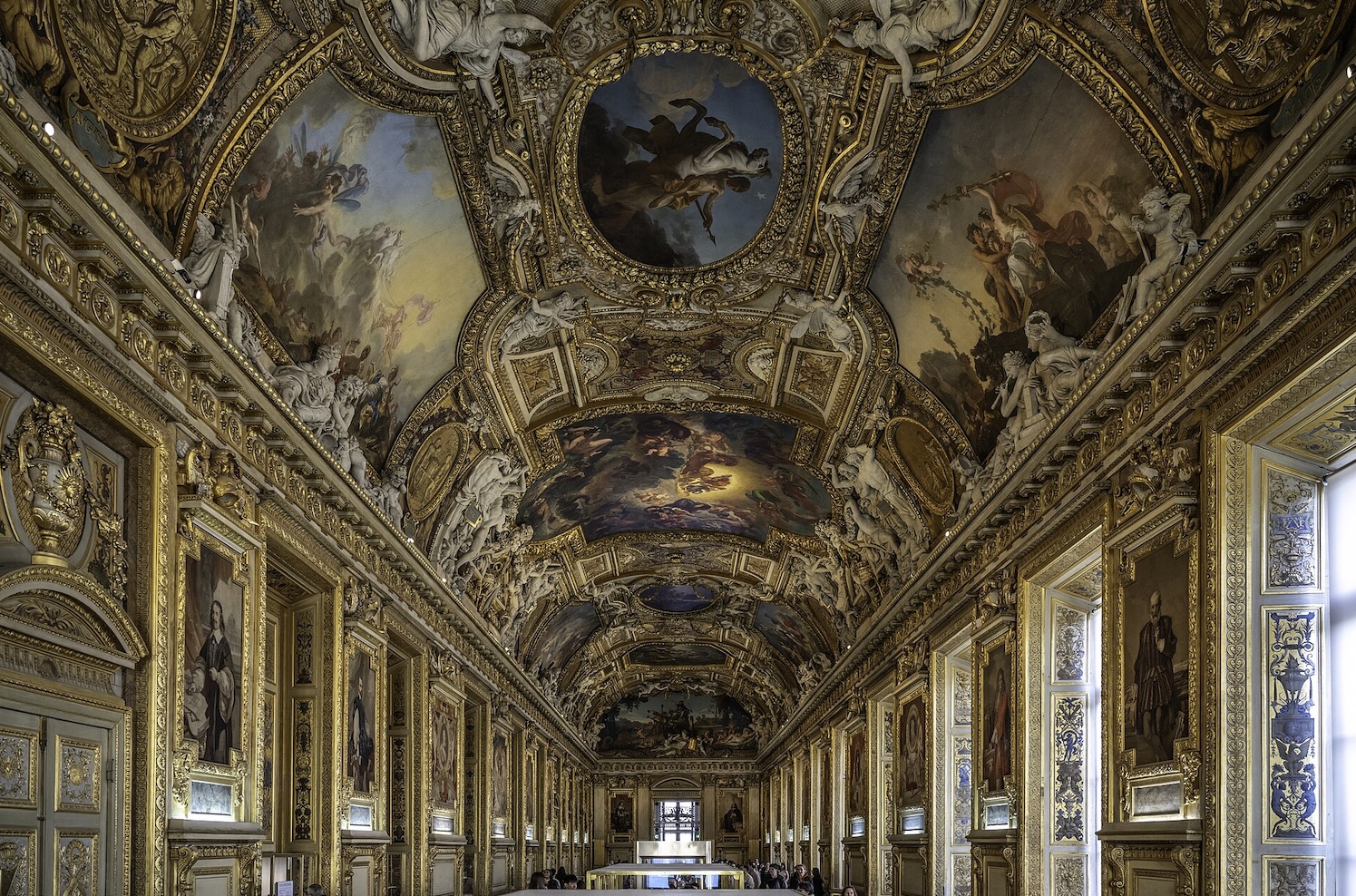
The Galerie d’Apollon has reopened without its jewels. And for the first time in generations, visitors are being invited to look not into the display cases, but at the room itself.
A Masterpiece Hiding in Plain Sight
At 56Paris, we often find ourselves talking about the difference between price and value.
It is particularly relevant in Paris.
The value of a beautiful apartment here is rarely explained by square metres alone. It may lie in its proportions, its light, an original fireplace, a staircase, a courtyard, the view from a window or simply the extraordinary continuity of a building that has survived several centuries of Parisian life.
The Galerie d’Apollon offers a rather magnificent version of the same lesson.
When it reopened on 22 July 2026, nine months after the theft, the precious objects and display cases that had occupied the gallery were gone. The Louvre deliberately returned the room to its original purpose: a galerie d’apparat, conceived in the 17th century as a work of art in its own right.
The effect is striking.
Without the jewels competing for attention, the eye travels upwards — to the painted ceiling, gilded stucco, sculpted figures and extraordinary decorative programme that unfolds across a room more than 61 metres long and 15 metres high.
What had become the setting for treasures is revealed as a treasure itself.
Sometimes Paris reveals another layer by adding something new.
Occasionally, it does so by taking something away.
Before Versailles, There Was the Louvre
It is easy to associate the theatrical splendour of Louis XIV almost exclusively with Versailles. But the Galerie d’Apollon came first.
After a fire destroyed part of the Louvre in 1661, Louis Le Vau was commissioned to rebuild the gallery, while Charles Le Brun conceived an extraordinary decorative programme centred on Apollo, the sun god.
The symbolism was anything but accidental.
Louis XIV increasingly associated himself with the sun, and Apollo offered the perfect visual language for royal power: light, order, harmony and dominion. Architecture, painting and sculpture were brought together to communicate a political idea through beauty.
The result was sufficiently influential that the Galerie d’Apollon later served as a model for the Galerie des Glaces — the Hall of Mirrors — at Versailles.
In other words, one of the most famous interiors in France owes something to a room that many Louvre visitors have hurried through on their way to something else.
A Room Created Over Centuries
Another thing we love about the Galerie d’Apollon is that, despite its extraordinary visual coherence, it was not created at a single moment.
It evolved.
Its decoration was begun in the 17th century but continued over some two hundred years, bringing together successive generations of France's leading artists and craftsmen.
In the 19th century, architect Félix Duban undertook a major restoration of the gallery. Eugène Delacroix was commissioned to paint its magnificent central ceiling composition, Apollo Slaying the Serpent Python, completed in 1851.
That accumulation is profoundly Parisian.
The city we know today was not created according to one plan or in one period. Medieval streets sit behind Haussmannian boulevards. 17th-century hôtels particuliers acquired 18th-century panelling and 19th-century additions. Apartments are altered, restored, divided and occasionally reunited.
The most interesting Parisian buildings are often those where the different chapters have not been erased, but understood.
For us, that is an important part of working with property here too. Good renovation is not about making an old apartment look new. It is about understanding what deserves to be preserved, what can evolve and how the two can coexist.
When Value Cannot Be Measured in Euros
The Louvre theft makes that distinction particularly stark.
The stolen jewels have an enormous financial value. But their cultural value is of an entirely different order.
They belonged to specific people, periods and moments in French history. They were made by extraordinary craftsmen using techniques that themselves form part of the country's artistic heritage. Once separated from that history and reduced to stones, gold and resale value, something far greater than their monetary worth is lost.
Perhaps that is what made the robbery feel so jarring.
Paris — and France more broadly — is built on the idea that certain things are worth preserving precisely because their value cannot be calculated entirely in financial terms.
A façade. A staircase. A painting. A garden. A piece of jewellery. A centuries-old building.
Or a gilded gallery inside the Louvre.
Paris Is More Than the Sum of Its Treasures
There is a wonderful irony in what has happened since the robbery.
The thieves came for the objects inside the Galerie d’Apollon.
In their absence, we have rediscovered the gallery.
Without its vitrines, it once again functions as its creators intended: not primarily as a display space, but as an extraordinary architectural experience — somewhere to walk, look up and take in the whole. The Louvre itself now describes it as a place for free contemplation at the heart of the museum.
It is difficult to imagine a more Parisian lesson.
Living here teaches you that the city's appeal rarely resides in one monument, one view or one beautiful object. It comes from the accumulation of them — architecture, craftsmanship, history, neighbourhood life and the countless details that become part of an ordinary Tuesday when Paris is your home rather than somewhere you visit.
At 56Paris, that is also how we think about real estate.
We help international clients buy and sell property, certainly. But understanding Paris property means understanding more than prices per square metre. It means recognizing why one building matters more than another, why original details are worth protecting, why a particular street or courtyard changes the experience of a home — and when something rare deserves to be treated as such.
Access matters. But intelligent guidance matters more.
The Galerie d’Apollon is open again. If you have not seen it since its reopening, it may be worth returning — and this time, instead of looking for the jewels, simply look up.
Thinking About Making Paris Your Home?
Since 2009, 56Paris Real Estate has helped international buyers navigate the Paris property market, from defining the right search and understanding neighbourhoods to evaluating individual properties, negotiating and completing the purchase.
Because good property decisions begin with understanding your objectives — and understanding Paris.
Start your search with 56Paris.
For more perspectives on Paris real estate, architecture and the cultural life that makes this city such an extraordinary place to live, follow 56Paris on Facebook, Instagram, YouTube and Pinterest.