
How One Man—and One Empire—Redrew the Map of Paris
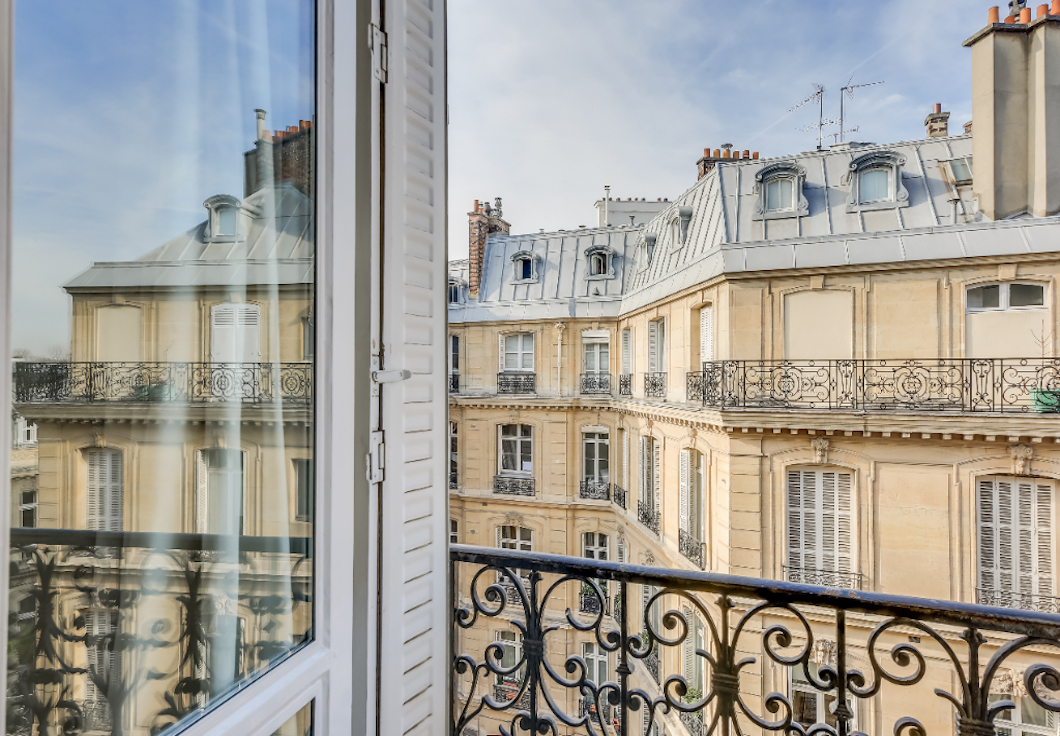
The streets of Paris have an unmistakable allure. Wide, light-filled boulevards lined with honey-colored stone. Buildings that rise in near-perfect harmony, crowned with zinc roofs that shimmer under shifting skies. Wrought-iron balconies tracing elegant lines across façades. Step inside, and the story continues: tall windows, marble fireplaces, intricate ceiling moldings, grand staircases, and beautiful entrance doors opening onto the street.
Much of this iconic Parisian aesthetic can be traced back to one man—Georges-Eugène Haussmann—and to the political vision of Napoleon III.
At 56Paris, we spend our days inside these buildings: climbing their staircases, opening their doors, reading the city through its façades. Anyone who falls in love with Paris—whether visitor, resident, or future homeowner—inevitably does the same.
What most people instinctively recognize as “Parisian” did not emerge gradually over centuries. It was conceived, regulated, and executed with extraordinary speed. To understand Paris real estate is to understand Haussmann. And to understand Haussmann is to realize just how radically modern Paris truly is.
If you are looking for property in Paris, there is no escaping this reality: you will be inscribing yourself into a city shaped by his vision—one that continues to define how Parisians live, move, and imagine the City of Light today.
Haussmann: The Man Behind the City
Born in Paris in 1809, Georges-Eugène Haussmann was educated at the Lycée Henri IV, beside the Panthéon in the Latin Quarter. He studied music at the Paris Conservatory before turning to law at the Faculty of Law on Place du Panthéon—an unconventional path for someone who would later reshape an entire capital.
Haussmann came from a family steeped in public service. His grandfather had been a general in Napoleon Bonaparte’s army, and Haussmann proudly described himself as a Bonapartist from birth. Rather than pursuing a military career, he entered the French civil service, building decades of experience as a regional administrator. His work focused on the practical realities of cities: infrastructure, public buildings, schools, and streets.
When Louis-Napoléon seized power in 1851 and became Emperor Napoleon III, he appointed Haussmann Prefect of the Seine—one of the most powerful administrative positions in France, responsible for Paris and its surrounding areas.
The emperor wanted a capital worthy of an empire. Haussmann was given unprecedented authority—and the mandate to reinvent Paris entirely.


i) Haussmannian interior of one of 56Paris's sold apartments ii) Artwork by Christophe Korfer iii) Haussmannian façade by Place de l'Opéra
Before Haussmann: A Medieval Capital
Until the mid-19th century, Paris was dense, dark, and often hazardous. Medieval streets twisted through the city in narrow, irregular patterns. Light and air were scarce. Sanitation and water supply were rudimentary. Epidemics spread easily.
These cramped streets also played a political role. During repeated revolutions and uprisings—1789, 1830, 1848—they became barricaded labyrinths, difficult for authorities to control. You can still glimpse this pre-Haussmann Paris in parts of the Marais, where medieval street patterns survive.
It was into this city that Haussmann stepped—armed not with architectural training, but with administrative power, a belief in order, and the unwavering support of Napoleon III.
The guiding priorities were clear: defense, hygiene, and circulation. Paris needed air, light, clean water, and movement—of people, goods, and ideas.
The Radical Plan That Changed Everything
Appointed in 1853, Haussmann launched one of the most ambitious urban transformations in history. Over the next 17 years, nearly 20,000 buildings were demolished and more than 45,000 new ones constructed. Entire neighborhoods disappeared. New districts rose at astonishing speed.
The human cost was significant: more than 100,000 residents were displaced, and many lived amid construction rubble for years. At the same time, the project employed nearly one-fifth of Paris’s workforce and injected unprecedented energy into the city.
What emerged was not chaos, but a city governed by clear, repeatable rules.
Wide boulevards replaced medieval alleys, allowing light and air to flow freely. Beneath the streets, a modern sewer and aqueduct network dramatically improved sanitation and access to clean water. Gas lighting illuminated Paris nights. Parks such as the Buttes-Chaumont, Parc Monceau, and the Bois de Boulogne introduced green space into urban life on a new scale.
Markets like Les Halles were rebuilt. Hospitals modernized. Major train stations—Gare de l’Est and Gare de Lyon—were integrated into the urban fabric. Bridges reconnected the Right and Left Banks.
Haussmann famously referred to himself as l’artiste démolisseur—the demolition artist. Yet destruction was only the means. What mattered was what replaced it.


i) Boulevard Haussmann ii) Portrait of Georges-Eugène Haussmann - the demolition artist iii) Construction of Place de l'Opéra 1873
The Haussmannian Building: Beauty by Regulation
Haussmann’s most enduring legacy is not a single monument, but a system.
Haussmannian buildings followed strict architectural codes: uniform height to create a coherent skyline; façades in pale limestone from the Paris basin; clearly defined floor levels. The étage noble—usually the second floor—was the most prestigious, marked by continuous balconies. Upper floors stepped back modestly, and mansard roofs crowned the buildings, often housing former chambres de bonne beneath the eaves.
Crucially, these buildings introduced modern comforts. Indoor plumbing replaced shared courtyard facilities. Every room had a window. Layouts were rational, with clear circulation and a distinction between public reception rooms and private spaces.
These were homes designed for comfort, hygiene, and elegance—principles that feel strikingly contemporary even today. This is why Haussmann apartments remain so sought-after: their proportions work, their light endures, and their beauty is structural rather than decorative.
It’s no coincidence that this architectural model has been copied in cities around the world.
Where to Experience Haussmann’s Paris Today
Haussmann’s boulevards quickly became the heart of Parisian social life. Cafés, shops, and theaters flourished, giving rise to the culture of strolling, observing, and lingering—the world of the flâneur.
Today, Haussmann’s vision is most visible along major arteries such as Boulevard Haussmann, Avenue de l’Opéra leading to the Opéra Garnier, and throughout large parts of the 8th, 9th, 16th, and 17th arrondissements, as well as many Right Bank neighborhoods reshaped under the Second Empire.
More importantly, Haussmannian style continues to shape expectations. When buyers say they are looking for a “classic Paris apartment,” they are almost always describing Haussmannian codes—whether consciously or not.
And when they choose something different—medieval charm, postwar modernism, or contemporary architecture—it is often in dialogue with, or in contrast to, Haussmann’s enduring framework.
A Legacy That Still Organizes Paris
Haussmann died in 1891 and is buried in Père Lachaise cemetery. Yet his legacy defines Paris to this day. The city remains walkable, coherent, and visually harmonious. Its streets frame monuments with theatrical precision. Its buildings speak a shared architectural language.
More than a century later, Haussmannian apartments remain among the most desirable urban homes in the world.
If you are searching for a home in Paris, understanding Haussmann is essential. Because once you recognize his imprint on the city, something profound becomes clear: Paris doesn’t simply look the way it does—it was designed to feel this way.
Those details, histories, and layers are part of what makes us tick.
At 56Paris, we love accompanying clients as they discover every facet of the City of Light—its architecture, its neighborhoods, and the stories written into its walls.
Contact us to begin your Paris real estate journey.
And for more insights into Paris property, architecture, and lifestyle, follow us on Facebook, Instagram, YouTube, and Pinterest.