
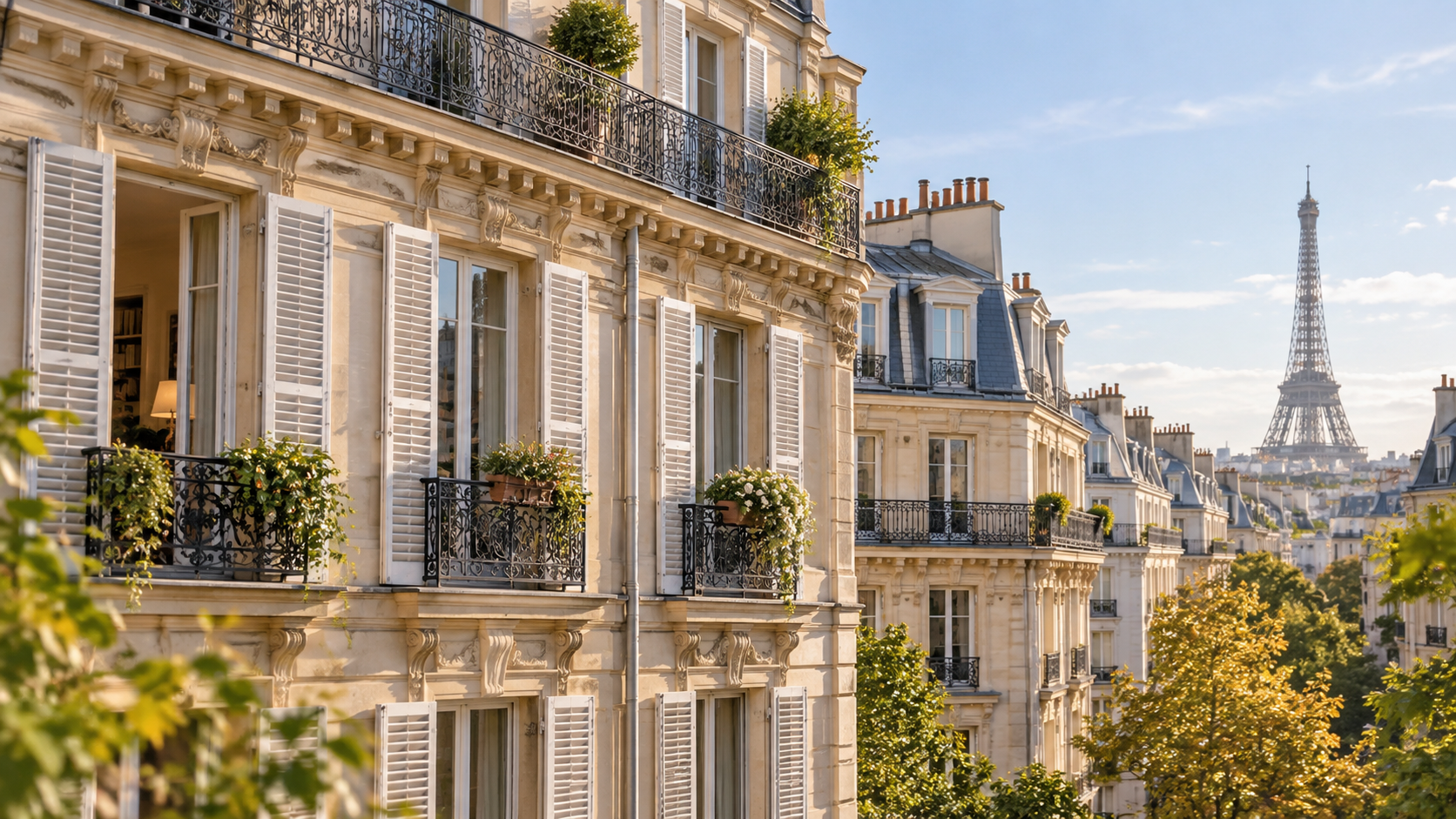
Paris Is Doubling Its Tax on Vacant Homes. Should Second-Home Owners Be Worried?
Paris has adopted a significant increase in the taxation of vacant residential properties from 2027, as part of Mayor Emmanuel Grégoire’s efforts to bring more housing back onto the market.
The announcement has understandably caused some concern among property owners — particularly international owners who use their Paris apartment as a second home.
But an important distinction has sometimes been lost in the headlines: the measure targets vacant homes, not second homes.
Why is Paris targeting vacant properties?
Housing availability has become one of the central political issues in Paris.
According to figures cited by the City, approximately 139,000 homes in Paris are classified as vacant, excluding second homes — close to 10% of the capital's housing stock. The City hopes that stronger taxation will encourage the owners of some 20,000 of these properties to either rent or sell them, thereby returning them to the residential market.
The reasoning is straightforward: in a city where housing is scarce and expensive, the municipality considers it increasingly difficult to justify leaving habitable apartments permanently empty.
The reality, however, can be considerably more nuanced.
Not every vacant apartment is being deliberately withheld from the market for speculative reasons. Properties may remain empty during an inheritance or legal dispute, while awaiting substantial renovation, or simply because an owner is reluctant to become a landlord.
And that reluctance is not necessarily difficult to understand.
Over recent years, Paris landlords have faced increasingly restrictive rules, including rent controls and progressively tighter energy-performance requirements. Add the risk of unpaid rent, property damage and the difficulty of recovering a property from a problematic tenant, and some owners — particularly families who have owned Paris property for many years — may simply prefer to keep an apartment empty rather than rent it.
The City’s new measure is intended to change that calculation.
What changes in 2027?
The 2026 Finance Law creates a new Taxe sur la Vacance des Locaux d’Habitation (TVLH) from January 1, 2027. It replaces the existing taxes applicable to vacant homes and, importantly, transfers the proceeds to the municipalities and intermunicipal authorities concerned.
In high-demand areas such as Paris, the national rates are normally:
* 17% of the cadastral rental value for the first year of taxation;
* 34% from the second year onward.
The law allows municipalities to increase those rates to a maximum of 30% and 60%.
Paris has chosen the maximum.
From 2027, a qualifying vacant Paris property will therefore be taxed at 30% of its cadastral rental value during the first year of taxation and 60% from the second year onward.
This is not 30% or 60% of the property's market value, nor of its actual potential market rent. The calculation is based on the property's valeur locative cadastrale, the administrative rental value already used for several French property taxes.
The City gives the example of a vacant 30 m² apartment in the 17th arrondissement. Under the previous system, its vacancy tax was estimated at approximately €790. From 2027, that would rise to approximately €1,400 for the first year of taxation and €2,800 thereafter.
The financial impact will therefore vary considerably from one property to another.
Who is actually concerned?
This is where the distinction becomes important.
The tax applies to homes that are genuinely considered vacant: broadly speaking, habitable residential properties that are unoccupied and insufficiently furnished for normal residential use, and which have remained vacant for the required period.
In Paris, the new tax applies to qualifying properties that have been vacant for at least one year.
There are also important exemptions. A property is not taxed when the vacancy is beyond the owner's control — for example because it is caught up in certain legal proceedings, requires substantial work before it can be inhabited, or has genuinely been offered for sale or rent at normal market conditions without finding a buyer or tenant.
A property occupied for more than 90 consecutive days during the relevant reference period is also excluded from the vacancy tax.
And what about Paris second homes?
This is probably the most important point for many international 56Paris clients:
A genuine second home is not a vacant property.
A furnished Paris apartment that its owner keeps available for personal use is treated as a résidence secondaire, not as a logement vacant. It falls under a different tax regime and remains subject to the taxe d’habitation applicable to second homes.
So the new Paris vacancy tax should not be confused with a new tax on foreign owners, pied-à-terre owners or people who simply do not live in Paris year-round.
It is specifically intended to target properties that are left vacant.
Your annual occupancy declaration matters
The distinction also makes your annual French property occupancy declaration increasingly important.
Since 2023, residential property owners have been required to tell the French tax authorities how each property is occupied through the “Gérer mes biens immobiliers” section of their online tax account.
You declare whether the property is your principal residence, a secondary residence, rented to somebody else or vacant, and update the declaration when the occupancy situation changes.
For 2026, changes in occupancy had to be declared by June 30.
Read our guide to the annual French property occupancy declaration
This declaration is not a minor administrative formality: it is one of the ways the tax authorities determine which property tax regime applies to your home. Incorrect or missing information can therefore result in the wrong tax being assessed.
The bottom line for Paris property owners
The headlines may sound alarming, but for most international owners who genuinely use their Paris apartment as a second home, this is not the new tax to worry about.
The measure is aimed at properties that remain vacant rather than homes kept and used as second residences.
For owners of genuinely empty apartments, however, the financial incentive is becoming considerably stronger. From 2027, leaving an otherwise habitable Paris property vacant could become significantly more expensive, particularly after the first year of taxation.
Whether taxation alone will persuade owners to become landlords is another question. Paris may discover that some properties remain empty not because their owners need an incentive to rent them, but because the regulatory and practical risks of renting have persuaded them not to.
That debate is unlikely to disappear.
For second-home owners, meanwhile, the practical advice is much simpler: make sure the occupancy status of your Paris property is correctly declared to the French tax authorities and updated whenever your situation changes (see link above).
Keeping Paris property news in perspective
French property and tax news can sometimes sound more alarming in a headline than it proves to be once the details are understood.
At 56Paris Real Estate, we aim to keep our clients and readers informed about developments affecting Paris property owners — and, importantly, to put them into the right context.
If you have questions about how these changes may affect your Paris property, please don't hesitate to contact us.
Otherwise, follow the 56Paris blog or subscribe to our newsletter, published every two weeks, to stay informed about the Paris property market, taxation and regulatory changes.
For updates at a glance, we also share key takeaways from our latest articles on Instagram.
Sources
Légifrance — Loi de finances pour 2026, Article 108: creation of the Taxe sur la Vacance des Locaux d’Habitation (TVLH), applicable from 2027, including the statutory tax rates, municipal powers to increase them, and exemptions.
2026 Finance Law – Article 108 (Légifrance)
Légifrance — Article 1406 bis of the French Tax Code: definition of a vacant property for purposes of the TVLH, the reference period, exemption for occupation exceeding 90 consecutive days, tax base and persons liable.
Article 1406 bis of the French Tax Code (Légifrance)
Légifrance — Décret n° 2026-831 du 25 août 2026: implementing decree defining the geographical scope of the new TVLH and confirming its replacement of the existing vacancy taxes from January 1, 2027.
Decree no. 2026-831 of August 25, 2026 (Légifrance)
Ville de Paris — Vacant housing: information on the application of the new tax in Paris from January 1, 2027, including the rates of 30% in the first year of taxation and 60% thereafter.
City of Paris – Vacant housing and the 2027 tax
French tax administration — Gérer mes biens immobiliers: official information concerning the declaration of occupancy status for residential properties.
impots.gouv.fr – Gérer mes biens immobiliers