
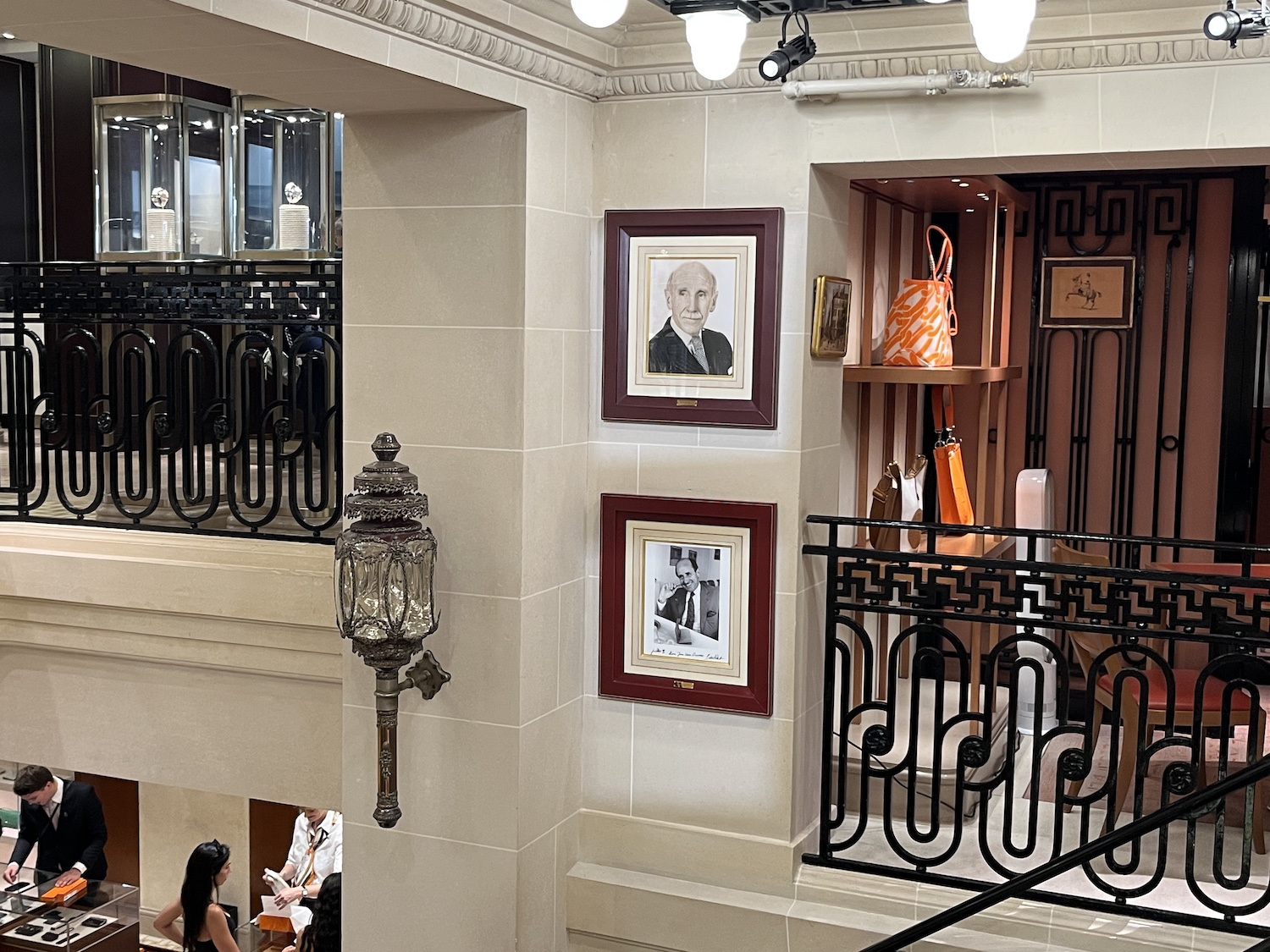
There is a building on the rue du Faubourg Saint-Honoré that has not changed hands in 145 years. It sits in the heart of the 8th arrondissement (district), surrounded by some of the most expensive real estate in the world, and it belongs — as it always has — to a single family. That family, the Hermès family, recently did something that would have seemed improbable even a decade ago: their company surpassed the French conglomerate LVMH (owners of Dior, Louis Vuitton and Moët & Chandon, among others) to become the most valuable business on the Paris CAC40. Not through acquisition, expansion or selling to anyone. But rather by holding firm, staying rooted and refusing to be anything other than what they were originally.
At 56Paris, we spend our days helping international clients — many of them American — find their own footing in this magical city. And we find ourselves returning, again and again, to a truth that Hermès makes visible in the most dramatic way: in Paris, the most enduring value is almost always found in the places and things that stand the test of time.


The Address That Never Changed: 24 Rue du Faubourg Saint-Honoré
In 1880, Charles-Émile Hermès moved his family workshop to 24 rue du Faubourg Saint-Honoré. It was a harness-maker's atelier — a craftsman's address in a street that was already becoming fashionable. More than a century later, the company is still there. The flagship store and headquarters remain on the same street.
For those familiar with Paris, rue du Faubourg Saint-Honoré occupies a distinctive place among the capital's most prestigious addresses. While only a short walk from the luxury boutiques of avenue Montaigne and the glamour of the Champs-Élysées, its atmosphere is notably more discreet.
Stretching between Place de la Madeleine and the Élysée Palace, and home to embassies, private clubs, art galleries and some of Paris's most established institutions, the street has long attracted a clientele that values privacy, heritage and understated elegance over visibility. It is a part of Paris where prestige is rarely advertised, yet immediately recognized by those who know the city well.
In many ways, the address reflects the spirit of Hermès itself. Rather than competing for attention, it embodies a quieter form of luxury rooted in craftsmanship, permanence and a deep connection to French cultural heritage. Like the house's creations, rue du Faubourg Saint-Honoré derives its appeal not from fashion or spectacle, but from a reputation patiently built over generations.
A Family That Held Firm: The Hermès Story
Between 2010 and 2014, LVMH — the world's largest luxury conglomerate, controlled by Bernard Arnault — quietly built a 23% stake in Hermès through financial instruments structured to stay under the radar. When the Hermès family discovered what had happened, they called Arnault le loup en cachemire — the wolf in cashmere. They restructured the company's ownership, united the family shareholders, and pushed back hard. By 2017, LVMH had sold off its stake and moved on.
The epilogue is what makes the story worth telling. In April 2025, Hermès's market valuation briefly overtook LVMH's, making it the most valuable company in the CAC40. Six generations of family ownership, nearly 190 years of unbroken continuity, a 41% operating margin — the highest in the luxury sector. The family had won, and won thoroughly.
They did it through depth — the kind of rootedness that takes generations to build and cannot be manufactured quickly, regardless of how much money is put to work.
What Paris Rewards: Continuity & Craft, Depth Over Scale
The Hermès story maps, more directly than you might expect, onto how the most thoughtful buyers approach Parisian real estate.
Paris rewards continuity. The Haussmann buildings that line the great boulevards of the 6th, 7th, and 8th arrondissements have appreciated steadily because they are irreplaceable. The supply of genuinely historic stone apartments in the heart of the city is finite, protected by heritage law, and subject to a level of global demand that shows no sign of thinning. There will not be more of them.
This logic is Hermès logic. The most coveted properties in Paris, like the most coveted objects in the world, derive their value precisely from the fact that they cannot be mass-produced. A beautifully preserved Haussmannien apartment in the Saint-Thomas-d'Aquin quarter (where our office is located) — with its original parquet floors, marble fireplaces, and 10-foot ceilings — is valuable for the same reason a Birkin bag is: it is the product of exceptional craft, held in limited supply, and associated with a place and a tradition the world has decided is without equivalent.
A City That Knows What It Is
Paris, like Hermès, is not in a hurry to become something else. The preservation laws that protect its Haussmann facades, its historic shopfronts, its courtyards and mansard rooftops are the very source of the city's value. The patient decision — made over generations — to keep buildings standing rather than tear them down and start again has produced one of the most valuable urban environments on earth.
For American buyers considering a property in Paris — a pied-à-terre in the 6th, a family apartment in the 7th, or a carefully chosen investment in the 8th — that history is perhaps the most useful context of all. You are buying into a city that has spent centuries being exactly what it is, with considerable success.
At 56Paris, that is exactly the kind of investment we help our clients make.
Interested in finding your own footing in the Paris property market? Contact the 56Paris team for personalized guidance from our bilingual experts, based in the heart of the city.
For more stories, insights from the world of Paris real estate or just to stay in touch, follow us on Facebook, Instagram, YouTube, and Pinterest.