
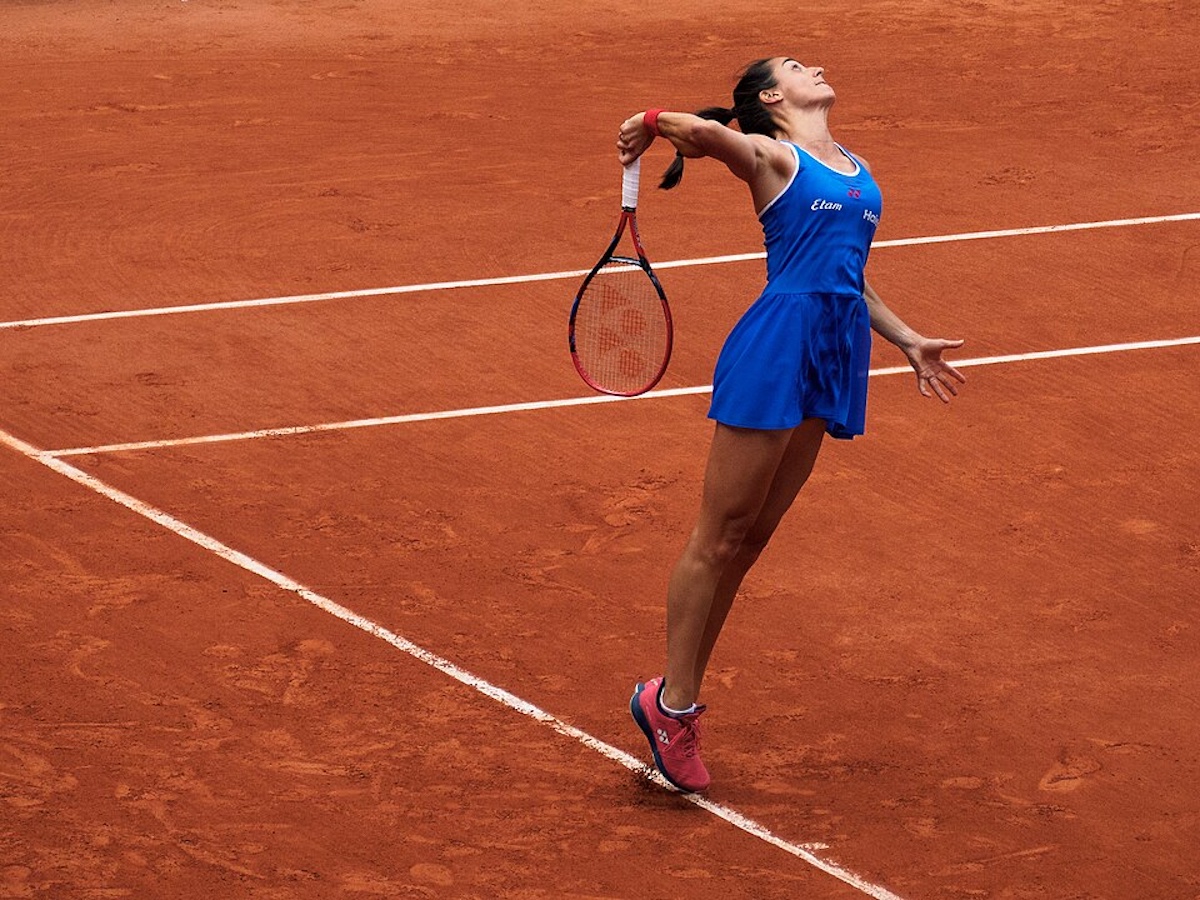
Caroline Garcia serving during her round match against Bernarda Pera at the 2025 French Open, credit: Kuberzog https://creativecommons.org/licenses/by-sa/4.0/.
At 56Paris, we have long believed that Paris is best understood through the stories layered beneath its surface — history embedded in a street name, character written into a building’s stone, or the way a neighbourhood preserves its identity across centuries. Roland Garros is precisely that kind of story.
Every May and June, the world turns its attention to the clay courts of Paris’ 16th arrondissement. Yet remarkably few of those watching know who Roland Garros actually was.
Visitors to the stadium often assume he was a celebrated tennis champion or an influential figure within the sport. In reality, Roland Garros never played professional tennis. Born on October 6, 1888, in Saint-Denis on Réunion Island, he would instead become one of France’s most admired aviation pioneers. A graduate of HEC Paris, he made history in September 1913 as the first aviator to complete a non-stop crossing of the Mediterranean Sea, flying from France to Tunisia.
During the First World War, Garros helped develop an early system allowing machine guns to fire through an aircraft’s propeller arc — a breakthrough that contributed to the emergence of effective single-seat fighter planes. Captured in 1915 after a forced landing in Belgium, he spent nearly three years as a prisoner of war before escaping disguised as a German officer. He returned to combat, only to be shot down on October 5, 1918, one day before his 30th birthday.
A decade later, in 1928, Paris inaugurated a new stadium to host the French Championships. Its constructor, Émile Lesieur — a close friend of Garros and fellow wartime aviator — agreed to build the venue on one condition: that it bear the name of his fallen companion. And so the Stade Roland-Garros was born.
Nearly a century later, that gesture of friendship remains one of Paris’ most enduring tributes — ensuring that each year, as the world gathers around the tournament, the name of an aviation pioneer continues to echo far beyond the sport itself.
I especially like ending on the idea that millions repeat his name without knowing the story. It ties back nicely to your opening about Paris revealing itself through hidden histories.
A Tournament More Than a Century in the Making
The origins of the French Open stretch back to 1891, when the first French Championships were held at Stade Français as a men’s interclub competition. Women’s singles followed in 1897, while women’s doubles were introduced in 1925 — the same year the tournament opened to international competitors. In 1928, play moved to the newly built Stade Roland-Garros, whose distinctive red clay courts would become inseparable from the identity of the event.
More than 130 years later, Roland Garros remains one of the most singular tournaments in world sport — not despite the clay, but because of it. The slow terre battue rewards patience, endurance and tactical precision, often favouring resilience over power. Few surfaces expose a player’s weaknesses so completely.
Its history has produced some of tennis’ most enduring records. Rafael Nadal holds an unprecedented 14 men’s singles titles at Roland Garros, earning the nickname “King of Clay,” while Chris Evert remains the most decorated woman in the tournament’s history with seven singles titles. Achievements that continue to define the scale of excellence demanded by Paris’ most celebrated sporting ritual.


The suspense of the final match between Sinner and Alcaraz in the 2025 French Open.
Why Roland-Garros Matters Beyond the Court
For those who live in Paris — or those contemplating it — Roland-Garros is not simply a sporting event. It marks a subtle transformation of the city’s western edge. The 16th arrondissement, long associated with elegant residential avenues and a quieter rhythm of life, takes on a distinct energy during these two weeks. Cafés near the Trocadéro fill early. The broad, tree-lined streets stretching toward Porte d’Auteuil become pathways for spectators and locals alike. There is something about late spring in Paris — the longer evenings, the anticipation surrounding the tournament, and the familiar cadence of the city — that makes this corner of Paris feel particularly alive.
For those who call the neighbourhood home, it is a ritual that returns each year. And perhaps one of the many reasons the 16th arrondissement continues to attract buyers seeking not only architectural prestige, but also an enduring quality of life.
We recently wrote about one such story — a property search that began with a structured brief and ended in something entirely unexpected: a rare apartment within the iconic Molitor building, designed by Le Corbusier and Pierre Jeanneret, only minutes from these very courts. That search served as a reminder that Paris’ most meaningful addresses are often found at the intersection of timing, culture, and thoughtful guidance.
The 16th arrondissement is also home to one of our current listings on Avenue Georges Mandel: a fully renovated three- to four-bedroom family apartment near Place du Trocadéro, where the grandeur of late 19th-century Parisian architecture meets the comfort and ease of contemporary living.
Living in the Neighbourhood That Hosts the World
There is something distinctive about calling the 16th arrondissement home during Roland-Garros. The tournament takes place in late May through early June — precisely when Paris is at its most generous. The light lingers well into the evening. The Bois de Boulogne, only a short distance from the stadium, is at its lushest. And the neighbourhood itself, with its broad avenues, distinguished architecture and quieter rhythm, reflects a way of living that feels both refined and enduring.
At 56Paris, we work with international and French clients who are searching not simply for a property, but for a context — a neighbourhood whose character continues to shape daily life long after the excitement of a purchase has passed. The 16th arrondissement has long attracted those who understand that in Paris, where you live inevitably shapes how you experience the city.
If Roland-Garros serves as a reminder of Paris at its finest — and of the particular atmosphere certain neighbourhoods offer — then perhaps it is also an invitation to look more closely at what makes an address feel right. Because finding a home in Paris has rarely been only about square metres or architecture. More often, it is about finding the version of the city in which you wish to belong.
For those considering that question, our approach to property search begins there.