
By Kerstin Bachmann, Founder of 56Paris Real Estate
On Friday, 13 November 2015, I was working late at our office on rue de Verneuil, in the 7th arrondissement. Outside, the neighbourhood had its familiar Friday-evening atmosphere: peaceful, yet pleasantly animated as people made their way to dinner or met friends.
I was about to close the shop when the first notification appeared on my phone: an attack at the Stade de France. Another followed, which I barely took the time to read as I headed out.
A taxi passed. For a moment, I wondered whether to hail it or take one of the city bikes I usually used to commute. It was a pleasant November evening. I chose the bike.
As I approached Hôtel de Ville, near where I live, I began to realise that something major had happened. Police cars and fire engines seemed to be everywhere. Sirens filled the streets. My instinct told me to get home as quickly as possible.
Only once inside did I begin to comprehend the full horror of what was happening to the city I love. My Paris.
I spent much of the night reaching out to my team and people I knew, and answering messages from family and friends. Our clients in the United States were writing too, anxious to know whether we were safe. Across the distance, their concern was deeply touching.
In the days that followed, Paris felt like a ghost town. There was sadness and disbelief where its usual energy should have been. We mourned those who had died, comforted those affected, and felt that strange, bittersweet relief on learning that someone we loved was unharmed.
Among the accounts I heard on television afterwards, one has stayed with me: an eyewitness speaking about a couple on rental bikes, caught in the attacks. I often think of them. I had been cycling home that evening too.
A garden for remembrance
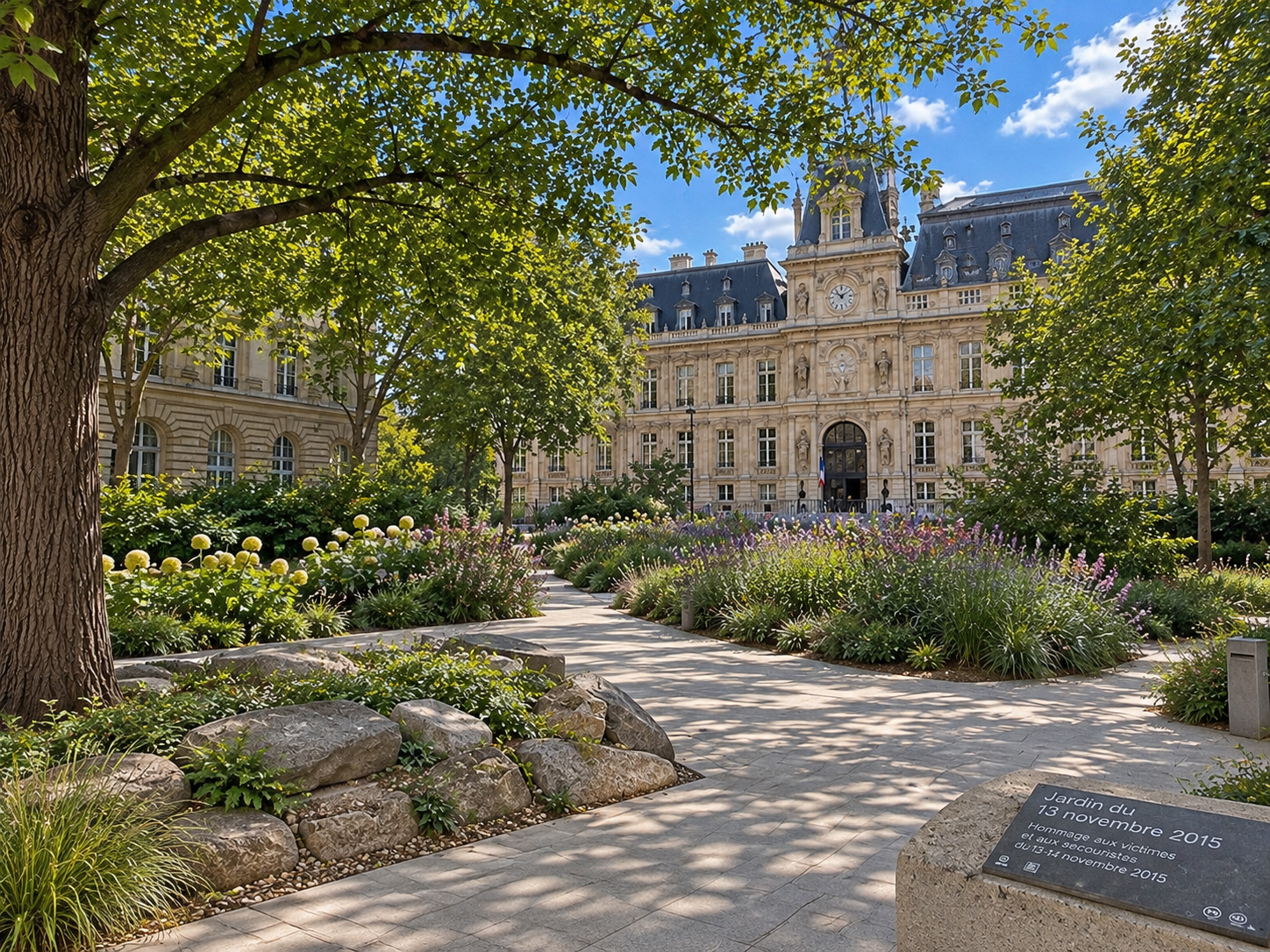
Today, eleven years later, there is a place between Hôtel de Ville and Saint-Gervais church where those memories can settle: the Jardin du 13 Novembre 2015.
Opened to the public in June 2025 and formally inaugurated on the tenth anniversary that November, the garden honours the victims of the attacks in Paris and Saint-Denis. Its stones bear 132 names, remembering both those killed that night and the victims recognised subsequently.
The project was led by Wagon Landscaping, with landscape designer Gilles Clément contributing to its artistic conception and Agence ON designing the lighting. Heritage architects, a historian of memory and other specialists also contributed. The victims’ associations 13Onze15 – Fraternité et Vérité and Life for Paris helped shape the project from its earliest stages. Their wish was for a garden: somewhere living, where people could gather and remember.
The choice of place Saint-Gervais was deliberate. Central to Paris, yet untouched by the attacks themselves, it could bring the different sites together in one shared place of remembrance. Its largely nineteenth-century architectural setting also called for sensitivity: the garden needed to belong within the historic square while giving it a renewed purpose.


Six places brought together
The garden’s layout draws on the streets and spaces around the six sites attacked that night. Their outlines have been brought together to create a new geography of remembrance. Planting emerges between fractured stone surfaces, softening their edges as it grows.
Six memorial stones of blue granite from Lanhélin in Brittany recall the Stade de France; Le Carillon and Le Petit Cambodge; La Bonne Bière and Casa Nostra; La Belle Équipe; Le Comptoir Voltaire; and the Bataclan. The names of the places appear on the outward-facing surfaces, while the victims’ names face inward, towards the garden.
In front of each stone, a bench offers somewhere to sit. This simple detail matters. There is time to read the names, to think about the lives behind them, or simply to remain still for a while. Shallow recesses in the stone collect water, providing drinking and bathing places for birds.
As evening falls, small amber lights glow among the plants. Designed to flicker like candle flames, they recall the lights people placed across Paris in the aftermath of the attacks. Their arrangement takes inspiration from the sky on the night of 13 November 2015. Soft lighting also illuminates the engraved names.
The garden changes with the seasons. Plants grow through the stone, birds visit, and everyday life continues around it. There is something profoundly moving about a memorial that makes room for all of this.
A place I return to
Despite living nearby, I discovered the garden almost by chance last summer, and only then learned about its inauguration. Perhaps I had been too absorbed in work and the rhythm of daily life to notice what had taken shape so close to home.
Since then, it has become part of my walks through Paris Centre. Sometimes I pass through; sometimes I stay. I see neighbours and visitors meeting, reflecting, or sitting quietly with their thoughts.
On that November night, I hurried through this part of Paris, wanting only to reach home. Today, there is a place here that invites me to pause.
I am grateful to the City of Paris, to the associations and to everyone who helped create this garden. They have given remembrance a beautiful and generous place in the life of the city.
The grief remains. So does our love for Paris, and for the everyday freedoms and pleasures that make it home: meeting friends, sharing a meal, listening to music, cycling through the streets on a mild evening.
For me, the Jardin du 13 Novembre 2015 gives quiet expression to the words that have long accompanied Paris:
Fluctuat nec mergitur.
Tossed by the waves, she does not sink.