
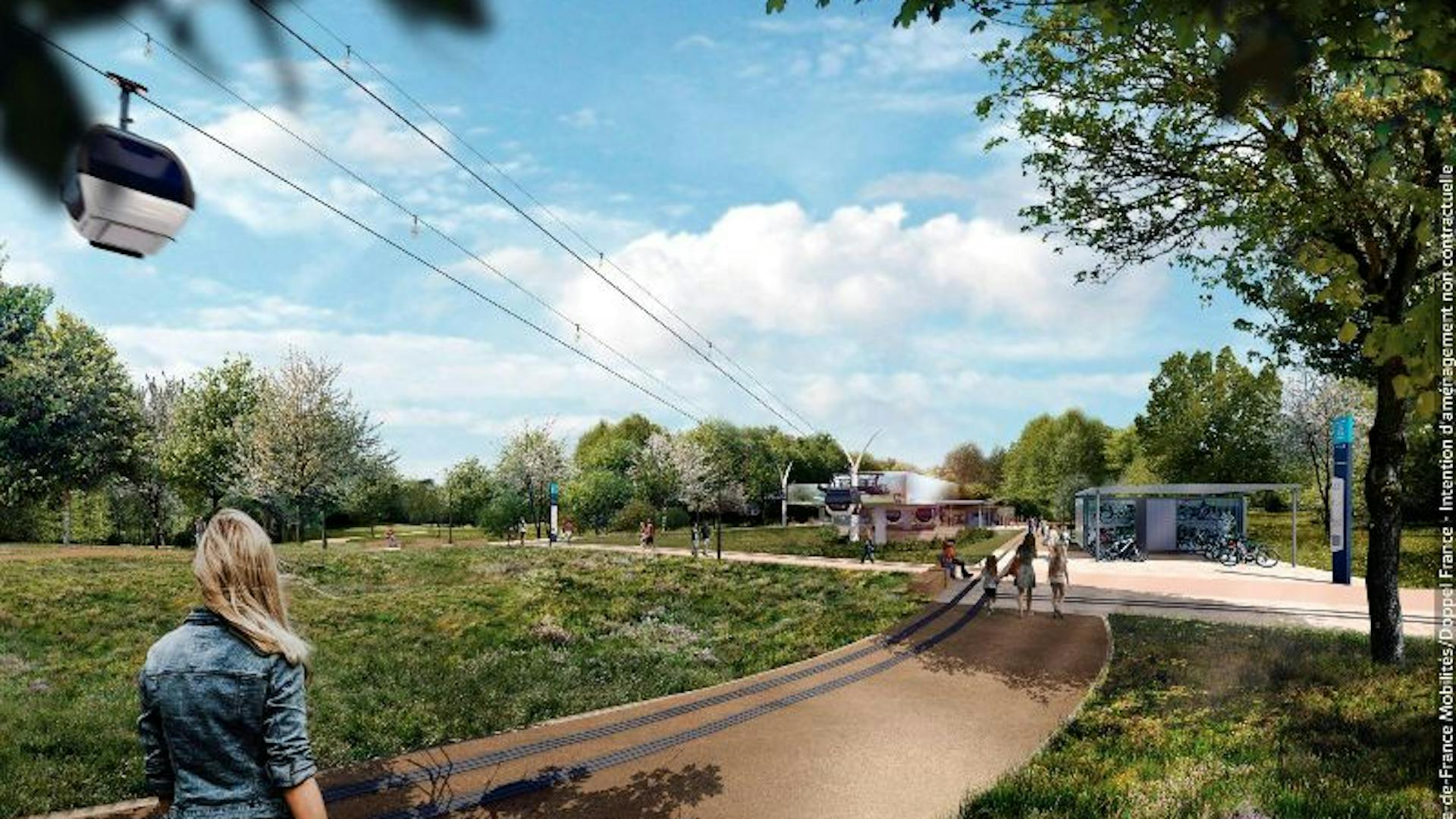
In December, Paris quietly inaugurated something rather extraordinary: its first urban aerial cable car.
For a city so often associated with 19th-century boulevards and historic métro lines, the launch of an aerial gondola might sound surprising. Yet at 56Paris, we’re consistently struck by how Paris — and the wider Île-de-France region — continues to modernise, adapt and experiment, often in thoughtful, human-scaled ways. This new cable car is a perfect example.
A First for the Paris Region
On December 13, officials inaugurated the Câble C1, the first urban cable car line in the Paris region. Stretching 4.5 kilometres, the route links Créteil–Pointe du Lac (the terminus of Métro Line 8) to Villeneuve-Saint-Georges, passing through Limeil-Brévannes and Valenton along the way.
The line consists of 105 gondolas, each seating ten passengers, gliding overhead at intervals of less than 30 seconds. The full journey takes around 18 minutes, less than half the time it previously took by bus or car — a change that residents describe as nothing short of transformative.
“It’s like skiing,” joked one local student on opening day. Regional president Valérie Pécresse summed it up poetically: “It’s the Alps on the Marne.”
Why a Cable Car for Paris?
Improved transport connectivity has long been one of the strongest drivers of neighborhood evolution and long-term property value across Greater Paris. Historically, cable cars were designed to cross mountains and ravines. Increasingly, however, cities around the world are rediscovering them as elegant solutions to complex urban problems — especially in neighborhoods isolated by geography, infrastructure gaps, or decades of underinvestment.
In this case, the southeastern suburbs served by C1 were poorly connected to the rail and métro network, despite being home to tens of thousands of residents. A traditional underground métro extension would have cost over a billion euros— a project that, as regional transport officials openly admit, would never have been financed.
By contrast, the cable car was completed for €138 million, making it not only innovative but pragmatic.
“This project bridges urban divides,” said Grégoire de Lasteyrie, Vice-President of the Île-de-France regional council for transport. “Its purpose is to connect areas that were previously left out of the network.”


All pictures and more information can be found on iledefrance-mobilites.fr
By the Numbers
* 4.5 km (2.8 mile) route
* 5 stations, spaced 500 to 1,800 metres (⅓ to 1 mile) apart
* 4 municipalities served
* 11,000 passengers per day expected
* 18-minute journey end to end
* 100% accessible cabins (wheelchairs, strollers, bicycles)
* Fully integrated with the Navigo pass
In practical terms, the aerial gondola doesn’t require a new ticketing system or learning curve. It simply becomes part of daily life — yet another strand in the dense weave of Parisian public transport.
A Long Road — or Flight — to Launch
What looks effortless from the ground took more than 20 years to realise. The project faced an obstacle course of challenges: funding negotiations, route refinements, overflight rights, legal adjustments, and the ever-present risk of political change.
For local residents, its arrival is deeply symbolic. Some of the neighborhoods now connected by the gondola are among the most disadvantaged in the department. Residents faced highly congested roads. This changes the equation.
Paris, Expanding Its Definition of Mobility
Câble C1 is France’s seventh urban cable car, joining systems already operating in cities such as Grenoble (where the iconic “bubbles” date back to 1934), Toulouse, Brest and Saint-Denis de La Réunion. It is also Europe’s longest urban aerial cable car, a title that underscores how far the idea has travelled — conceptually and literally.
Beyond novelty, the project reflects a broader shift in how Greater Paris thinks about mobility: lighter infrastructure, faster deployment, lower environmental impact, and better access for people previously left at the margins of the network.
Paris Looking Ahead — Safely
There’s one final detail worth noting. Aerial gondolas are considered among the safest forms of transport in the world, with decades of proven reliability in demanding environments — from ski resorts to dense urban settings. Inside each gondola, surveillance systems and emergency call buttons are paired with staffed stations and rigorous oversight.
In other words, what may look futuristic is, in fact, grounded in some of the most established transport engineering available.
At 56Paris, we see projects like Câble C1 as emblematic of a region that refuses to stand still but rather continues to invest in connectivity, inclusion and quality of life. Whether you live in central Paris or the wider metropolitan area, these developments quietly reshape what it means to move, to live, and to belong here.
Paris may be famous for its streets — but increasingly, it’s also thinking in three dimensions. And we’ll be watching closely as Paris continues to rise — quite literally — to meet the future.
Contact us today to begin your journey in Paris real estate.
For more stories, insights from the world of Paris real estate or just to stay in touch, follow us on Facebook, Instagram, YouTube, and Pinterest.