
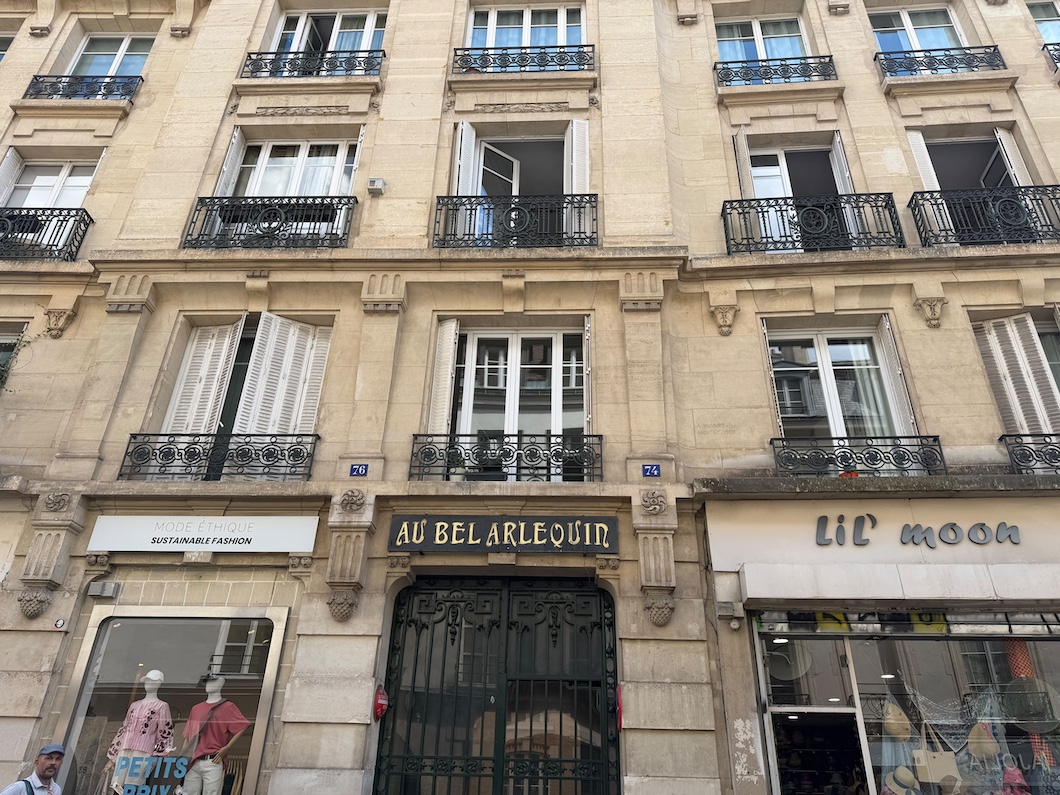
Walk down a street in the Marais on a quiet morning and you will notice something that is easy to take for granted: the storefronts look the way they have always looked. The painted woodwork, the brass fittings, the deep-set display windows—none of it is preserved by accident, nor is it purely sentimental. Paris has built an intricate legal framework to safeguard these historic facades, and for anyone considering buying property in Paris, that framework is part of what makes a central Paris address so enduringly valuable.
At 56Paris, we work primarily in the neighborhoods where this protection is most deeply felt—the Marais, the 6th, the 7th arrondissements (districts), and the surrounding areas that make up the historic heart of the city. Understanding what these laws do, and why they exist, is part of understanding what you are actually buying when you invest in central Paris.
Historic Shopfront Protection in Paris: The Loi Malraux Explained
The story begins in 1962, with a law named after André Malraux, then France's Minister of Culture. The Loi Malraux created a new planning concept—the secteur sauvegardé, or preserved sector—that placed entire historic neighborhoods under a unified protective regime. It's the law that made Paris's historic fabric a matter of state interest rather than just private property. The idea was straightforward in its ambition and radical in its implications: that the fabric of a historic city is a collective inheritance, and that the state has both the right and the responsibility to protect it.
Paris has two secteurs sauvegardés: a significant portion of the Marais, and part of the eastern 7th arrondissement (the same neighborhood as our office). Within these zones, no modification to a building's exterior—a shopfront, a facade, a doorway—can proceed without formal authorization. Those authorizations are reviewed and approved by the Architecte des Bâtiments de France (ABF), the “architect of the buildings of France,” a specialist appointed by the state whose role is to ensure that any change respects the historic character of its locale.
Beyond these two zones, the Malraux law’s protective reach extends farther than most people realize. The great majority of central Paris falls within the heritage protection perimeter of a listed monument—the Louvre, Notre-Dame, the Palais-Royal—meaning that ABF oversight applies across an enormous swath of the city's most desirable addresses.


Different historic storefronts found in one of Paris's protected areas, Marais.
What Paris Heritage Law Protects—and What It Means for Owners
The law functions simultaneously as a heritage protection document and a local planning code: prescriptions can apply to a single building, a single facade, or even specific interior features when work is being undertaken.
For shopfronts specifically, the rules are precise. A historic shopfront must be preserved in its original appearance. Any closure system—shutters, grilles, security screens—must disappear from view when the shop is open, concealed within the architecture rather than left visible on the facade. Signage is tightly regulated, and illuminated advertising is often prohibited outright.
Even outside protected zones, the law has something to say. Across Paris as a whole, any modification or creation of a commercial shopfront requires a prior declaration to the city. The shopfront, in French planning law, is understood to encompass the entire architectural face of a shop: the display window and its frame, the sign band above, the closure system, and the lighting. All of it, taken together, is considered part of the public realm—something whose appearance concerns not just the owner but the street, the neighborhood, and the city.
Why Paris Treats Its Storefronts as Cultural Heritage
Some of the facades protected under these laws are genuine artifacts—hand-painted lettering, carved wooden moldings, tiled interiors that document the commercial and social life of the city across generations. The tabac (cigarette shop) with its original 1930s facade, the fromagerie (cheese shop) whose sign has not changed since the Liberation, the librairie (bookstore) whose painted woodwork carries the name of a long-departed bookseller: these are the small, specific accumulations that make the Marais feel like the Marais, or a street feel like itself. France has chosen to treat this visual fabric with the same seriousness brought to protecting a cathedral or a manuscript—and the Architecte des Bâtiments de France, far from being a bureaucratic obstacle, functions more like a curator whose territory happens to be the street.
What This Means for Real Estate in Central Paris
For buyers considering a pied-à-terre or longer-term Paris property investment in one of these arrondissements, the implications are worth understanding clearly.
Heritage protection is a stabilizing force. In streets governed by the ABF's oversight, the visual character is legally guaranteed to remain consistent. A landlord two doors down cannot install a glass curtain wall or a neon sign that transforms the character of the street. The cafe across the courtyard cannot be replaced by something that looks entirely out of place.
The market reflects this. Commercial rents in the Marais reach up to €6,000 per square metre per year, with a vacancy rate of just 2.2%—figures that reflect not only the neighborhood’s popularity but also confidence that its character will be preserved. For residential buyers, the same logic applies: you are buying into a protected environment whose aesthetic coherence is underwritten by the French state.
There is also a practical dimension for owners who undertake renovation work. Within protected sectors, any project touching the exterior of a building will require ABF approval, and for buyers, working with architects and contractors familiar with these requirements is essential. The process adds a layer of complexity—but it also ensures that the work meets a standard of quality and historical coherence that ultimately benefits the entire building and street.
Why Central Paris Neighborhoods Hold Their Value
One of the things we find most compelling about working in central Paris is that its most beautiful neighborhoods are not beautiful by accident. The Marais did not preserve its 17th-century hôtels particuliers through luck. The Saint-Germain-des-Prés district did not maintain its character through the goodwill of successive property developers. These places look and feel the way they do (quintessentially Parisian) because generations of legal, architectural and cultural work has been devoted to keeping them that way.
The Loi Malraux represents a mindset that the visual fabric of a great city is worth protecting with the same seriousness brought to protecting a medieval manuscript. For anyone buying property in central Paris, that decision is quiet but powerful guarantee—one that has been working, in the background, every day since 1962.
Thinking about buying a Marais apartment, a home in the 6th or 7th arrondissements, or a pied-à-terre in central Paris? Contact the 56Paris team for personalized guidance from our bilingual experts, based in the heart of the city.
For more stories, insights from the world of Paris real estate or just to stay in touch, follow us on Facebook, Instagram, YouTube, and Pinterest.