
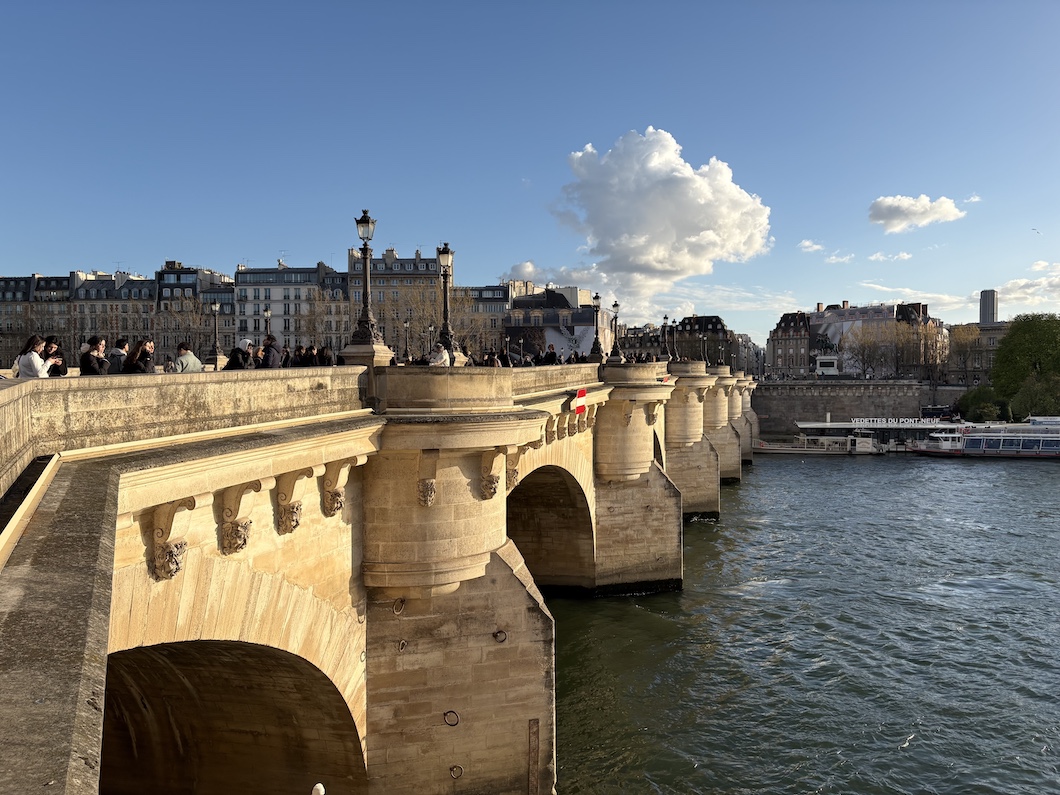
There are moments in Paris when the city reminds you—quite clearly—that it is not a museum. Rather, those who live in the city get to see it as a stage. A testing ground. A place where artists are still allowed to dream at scale, and where those dreams can quite literally reshape the urban landscape.
One of those moments is coming in June 2026, when the Pont Neuf, Paris’s oldest bridge and one of its most beloved landmarks, will undergo a daring transformation by the artist JR. For just over three weeks, from June 6 to 28, the bridge will become La Caverne du Pont Neuf (The Pont Neuf Cave): a monumental, immersive installation that will turn this familiar crossing into something entirely unexpected.
In early summer, this is one of the city’s most human places—joggers at dawn, couples lingering at sunset, Parisians leaning on the stone parapet with a baguette.
We have known JR—Paris-born contemporary artist, filmmaker, and master of illusion—for work that explores how art can reshape how we see the world. His enormous installations have graced monuments from Havana to Rio de Janeiro and Shanghai. But we at 56Paris also happen to know this particular project’s antecedent.
This June will be the kind of event that happens once in a generation. And it deliberately echoes another once-in-a-generation moment that also took the City of Light as its backdrop. Here’s the full story:
A Bridge Wrapped into History
More than forty years ago, in 1985, the artist duo of Christo and Jeanne-Claude achieved what many thought impossible: they wrapped the Pont Neuf in a golden-beige fabric veil, transforming the bridge into a temporary sculpture. The project took a decade of planning, enormous technical ingenuity, and unwavering conviction. When it finally appeared, it stopped Paris in its tracks.
For two weeks, more than three million visitors came to see the metamorphosis and walk atop the fabric. People picnicked nearby, argued about whether it was genius or madness, and came back twice—once alone, once with friends—just to see how the light changed it.
A decade later, they would wrap Berlin’s Reichstag—but it was Pont Neuf that entered Parisian memory. In 2025, Paris officially marked its importance by inaugurating the “Place du Pont Neuf – Christo et Jeanne-Claude,” and thus forever attaching their name to it. Few temporary artworks are honored that way.
Now, four decades later, that legacy is being extended.
The New Pont Neuf Installation: Entering the Cave
Conceived in collaboration with the Christo and Jeanne-Claude Foundation and the Paris Bridges Association, JR’s The Pont Neuf Cave will envelop the bridge in a dramatic, rock-like architecture. JR's vision draws inspiration from the quarries that supplied the bridge's stones, highlighting the origins of Paris's architecture.
JR will transform the Pont Neuf into a giant grotto that pedestrians can enter, walk through, and experience from multiple perspectives—above, below, and even from the Seine.
Seen from the riverbanks, it will be a vision to behold mid-walk, ice cream melting, as boats drift past beneath it.
The giant metamorphosis will be open day and night, free to the public; the bridge will be closed to vehicle traffic for the duration. Hundreds of engineers, builders, and craftspeople are involved in bringing it to life. As with Christo and Jeanne-Claude’s projects, it is financed entirely through private patronage.
This is Paris, still willing to let something audacious happen at its very center.


i) Sign of Place du Pont-Neuf Christo and Jeanne-Claude ii) Christo’s Arc de Triomphe Wrapped from 2021 iii) Pont Neuf spotted in the Paris spring weather
Why Does the Pont Neuf Installation Evoke a Cave?
The choice of a grotto is intentional.
For JR, The Pont Neuf Cave is the culmination of a cycle of works begun in 2020, which has as a theme the growing disconnection and alienation of city dwellers. He created several monumental trompe-l’oeil installations, which create the illusion of cracks or caves on iconic buildings in Italy (Florence, Rome, Milan) and on the facade of Paris’s Garnier opera house (2023).
For JR, the cave is a powerful metaphor rooted in Plato’s allegory of the cave, which asks us to question perception, illusion, and truth. In Plato’s story, humanity mistakes shadows for reality. JR draws a contemporary parallel: today, our “shadows” are screens, algorithms, curated feeds that fragment our understanding of the world and of one another.
Art, he insists, does not provide answers but creates space for reflection. And sometimes, simply, it creates a reason to stop on a bridge longer than planned.
The cave also reaches further back, to the origins of human expression, when people first marked walls. JR often points to this lineage, connecting his own beginnings in graffiti to humanity’s earliest artistic gestures. The Pont Neuf Cave becomes, in this sense, both ancient and utterly of the present moment.
Paris as the Culmination Point
For JR, creating this project in Paris is deeply personal.
Paris is where he began pasting his first images: on the Pont Louis-Philippe, along the banks of the Seine, from Rue de Rivoli to the Panthéon. It is the city that shaped him—and the one he keeps returning to. To realize a project of this scale, in his own city, carries particular weight.
Paris, he has said, remains a capital where you are still allowed to dream big. After the global visibility of the 2024 Olympic and Paralympic Games, he sees 2026 as another culturally charged year—in which Paris continues to assert itself as a living laboratory for contemporary creation.
A City That Never Stops Becoming
At 56Paris, we recognize this rhythm well.
We were there in 2021 when, decades after he first wrapped the Pont Neuf, Christo’s Arc de Triomphe, Wrapped finally came to life—sixty years after it was first imagined. We even kept a small swatch of that silvery-blue fabric, a reminder that some of the most powerful experiences in Paris are fleeting by design.
JR’s Pont Neuf project is another link in that chain. Another moment when the city allows itself to be transformed—not permanently, but meaningfully. These are the experiences that stay with you, that shape how you inhabit Paris, that remind you why living here feels different.
In June 2026, one of the city’s most familiar crossings will become something else entirely. And then, just as Christo and Jeanne-Claude intended, it will disappear—leaving behind memory, conversation, and the sense that you witnessed something that will never happen in quite the same way again.
Living Paris, Not Just Visiting It
This is perhaps where the connection to real estate becomes most meaningful.
Owning or living in Paris is not only about architecture, addresses, or investment—it is about proximity to these moments. To step outside and encounter something extraordinary. To witness the city reinvent itself, again and again.
In June 2026, the Pont Neuf will become something else entirely. And then it will disappear. What remains is the memory of having been there—not as a visitor, but as someone who calls Paris home. If you are considering a home in Paris, we at 56Paris would be delighted to guide you.