
In 2022, France spent €248 million restoring a library. Yes, but not just any library.
The Richelieu site of the Bibliothèque nationale de France—the historic birthplace of France's national library, built around the former palace of Cardinal Mazarin—is like France’s Smithsonian. It holds over 40 million documents: illuminated manuscripts, medieval maps, Victor Hugo's handwritten manuscript of Notre-Dame de Paris (The Hunchback of Notre-Dame), Simone de Beauvoir's famous Le Deuxième Sexe (The Second Sex). For most of the library’s history, you needed scholarly credentials to get past the door. The recent renovation changed that, and the scale of the investment—12 years, a quarter of a billion euros, some of France's finest heritage architects—says something about what Paris considers important. (Plus, it’s now one of the spots we recommend everyone visit!)
At 56Paris, we work primarily in the neighborhoods where that kind of cultural seriousness is most concentrated: the historical heart, including the 2nd arrondissement, where the BnF Richelieu sits. We spend our days thinking about what makes a Paris address genuinely exceptional—and we find that the city's most compelling neighborhoods tend to be the ones where cultural and intellectual life surfaces prominently. The 2nd arrondissement, long underestimated by those who focus exclusively on the Left Bank, is one of those neighborhoods. The transformation of the BnF Richelieu is a wonderful illustration of why.


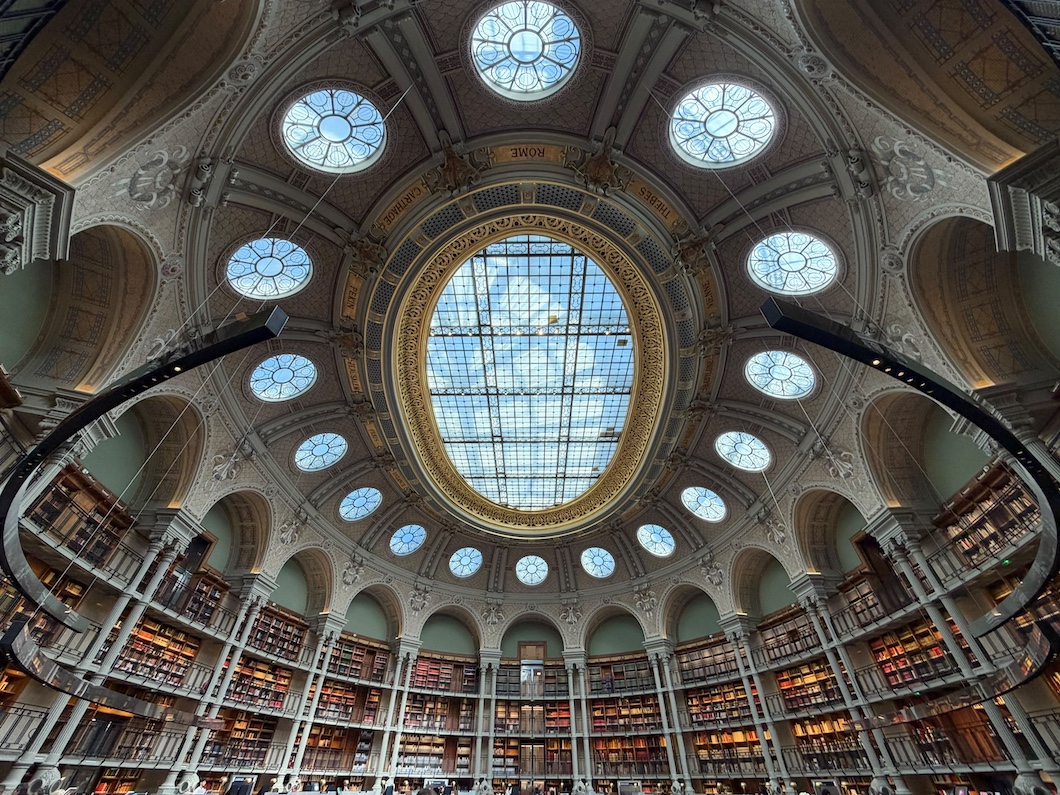
The exterior of the BnF and a few peaks inside the iconic library - could you find Victor Hugo's hand-written manuscript among these shelves?
A Palace Turned Library: The History of the BnF Richelieu
The history of the Richelieu site is a miniature history of Paris itself. Cardinal Mazarin—chief minister to the young Louis XIV and one of the 17th century's great art collectors—assembled the site from parcels in 1643, commissioning the famous architect François Mansart to build two superimposed galleries now frescoed with Romanelli's baroque paintings. The Royal Library arrived in 1721, and for three centuries the building grew floor by floor as successive architects—Robert de Cotte, Henri Labrouste, Jean-Louis Pascal—each left his mark. By the time renovation began in 2010, the complex covered about 625,000 square feet across 13 levels, with 30 staircases that bore no coherent relationship to one another and, in places, 14 superimposed floors of different historical periods. Phew!
The Renovation: A Masterclass in Thoughtful Restoration
The architects entrusted with the project, Bruno Gaudin and Virginie Brégal—whose firm previously guided the renovations of the Musée Marmottan-Monet and the Musée Guimet in Paris (also excellent work!)—approach historic buildings as layered texts to be read and respected. It might have been simpler to clear out centuries of accumulated additions and begin again, but the team chose instead to give the complex, for the first time in its history, an overall coherence—streamlining circulation, restoring dilapidated interiors, and opening up previously inaccessible spaces to the public.
The results are extraordinary. The Oval Room—the iconic 19th-century reading room—was completely restored and refurbished, with updated lighting and new multimedia seating. Previously reserved for credentialed researchers, it is now open to all, seating 150 people with more than 20,000 volumes in open consultation. (And yes, you’ll find videos of its stunning interior on all social media platforms, because visitors enter with their jaws dropped open and immediately take out their phones.) The Galerie Mazarin, with its restored baroque frescoes, houses a museum presenting 900 works from antiquity to the present. Rooms closed for generations—including Mazarin's private bedroom—are now part of a self-guided architectural walk running from the 17th to the 21st centuries.
The Garden That Reads Like a Book: The Hortus Papyrifer
Among the renovation's most remarkable elements is the Vivienne Garden, or Hortus Papyrifer — the “paper garden”— designed by the celebrated landscape artist Gilles Clément with architects Mirabelle Croizier and Antoine Quenardel. Every plant was chosen for its relationship to the written word: paper mulberry, bamboo, rice-paper plant, papyrus, paper birch. The garden occupies the exact spot where Cardinal Mazarin had his palace garden laid out in the 17th century. After decades of being paved over, the garden restored the soil itself, following agroecological methods that reintroduced earthworms and microorganisms.
The garden's ambition is to open the library to the outside world, revealing the relationship between the institution's collections and the living materials from which its documents were made. The garden explains, through plants, what a library is.
The 2nd Arrondissement: Central Paris Real Estate With a Rich Past
The BnF Richelieu renovation speaks directly to what makes a Paris neighborhood worth investing in for your primary home or pied-à-terre for the long term.
The 2nd arrondissement is among the smaller of Paris's twenty districts, but few pack more history into fewer streets. These are the blocks where 19th-century financiers, publishers, and booksellers built the neighborhood's character—the covered passages of the Galerie Vivienne and the Passage des Panoramas are among the finest in Paris, the Bourse de Commerce is nearby, and the rue Montorgueil market street still functions as it has for centuries.
Property here attracts buyers drawn to the texture of historic Paris rather than its postcard version: Haussmannian stone, quiet courtyards, streets that have been continuously inhabited and valued for longer than most cities have existed. For those considering a pied-à-terre in central Paris or a longer-term residential investment, the 2nd offers proximity to the 1st arrondissement and the Marais at prices that continue to represent genuine value—with the cultural infrastructure of the BnF Richelieu now added to an already remarkable neighborhood profile (including strolls in the Palais-Royal gardens).
At 56Paris, we believe that buying property in Paris is best when you understand the city's deeper logic—the way it protects what it values, and the way that protection, over time, becomes the very source of value itself. The BnF Richelieu is one of the most compelling illustrations of that logic that Paris has produced in years.
Thinking about buying in the 2nd arrondissement, the Marais, or elsewhere in historic central Paris? Contact the 56Paris team for personalized guidance from our bilingual experts, based in the heart of the city.
For more stories, insights from the world of Paris real estate or just to stay in touch, follow us on Facebook, Instagram, YouTube, and Pinterest.