
A blue door on rue de l’Université. Beyond it, a cobbled courtyard, gilded salons and a garden concealed from the street. Just around the corner from our office at 56, rue de Verneuil, the Hôtel de Maisons holds a remarkable amount of Paris behind a single entrance.
Karl Lagerfeld made a home here. A member of the family whose name the house also bears inspired a film seen around the world. More recently, the property has found itself caught between the ambitions of an international design fair and the financial affairs of a foreign state.
This October, Design Miami Paris opened its doors once again. With the fourth edition now concluded, it is the house itself that lingers in the imagination. How did one address come to contain so many different worlds?
An invitation inside
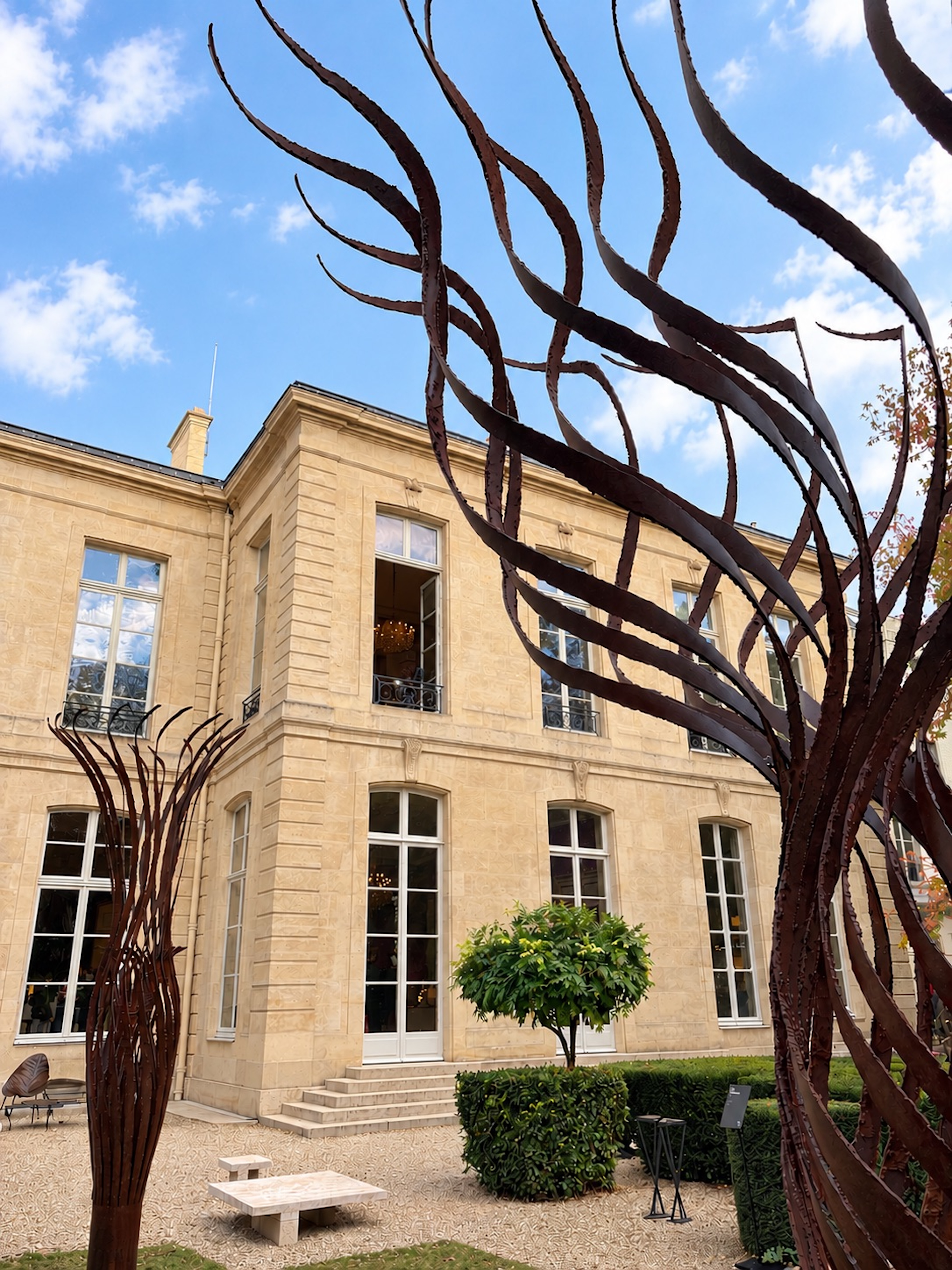
From October 21 to 25, following previews on October 20, visitors to Design Miami Paris could explore a setting usually hidden from view. At 51, rue de l’Université, the fair’s collectible furniture and contemporary objects occupied rooms with more than three centuries of history behind them.
In the garden, Maison Parisienne presented Pierre Renart’s Arabesque bench, its sinuous form inviting the eye to follow every curve. Galerie Patrick Seguin brought a Jean Prouvé demountable house, with an interior conceived in the spirit of a Japanese tea pavilion. A house designed to be taken apart and moved, installed in the grounds of an aristocratic Paris mansion: the encounter was part of the pleasure.
Inside, the exhibitors included Galerie Mitterrand, showing work by François-Xavier and Claude Lalanne, and Swedish gallery Modernity, bringing Scandinavian design to the fair. Here, the architecture participates in the exhibition. A modern chair sits beneath an ornate ceiling; a sculptural object takes on a different presence against historic paneling. The rooms invite you to imagine living with what you see.
A house designed to impress
That relationship between architecture and display goes back to the beginning. An hôtel particulier is a private urban mansion. In this part of the Faubourg Saint-Germain, its entrance, courtyard and garden allowed the owner to create an entire domestic world within the city.
The Hôtel de Maisons began taking shape in 1706, to designs by Pierre Cailleteau, known as Lassurance. Claude de Longueil, marquis de Maisons, acquired it while it was almost complete. The Soyecourt family later transformed the interiors, moving the principal staircase as part of extensive work in the mid-18th century. In 1839, the property passed to the Pozzo di Borgo family.
Each name survives: Hôtel de Maisons, Hôtel de Soyecourt, Hôtel Pozzo di Borgo. They are reminders of successive households making the same building their own. Even the monumental entrance deserves a closer look. Together with the garden façade, it has been protected as a historic monument since 1926.
Karl Lagerfeld’s private Paris
For roughly three decades, Karl Lagerfeld was a tenant here, occupying an apartment within the mansion. It was an extraordinary setting for a designer whose curiosity extended far beyond clothes.
His fascination with the 18th century filled the rooms with French furniture, paintings, tapestries and decorative objects. A photograph of his yellow bedroom reveals a Louis XVI bed dressed in silk and crowned with ostrich feathers. These were interiors conceived with the imagination and precision of someone accustomed to creating a complete world.
Then, as his tastes evolved, he let much of that world go. In 2000, a major collection of his French furniture and art was dispersed at Christie’s. The house had accommodated another reinvention. Seen in that light, its present role as a meeting place for collectors and designers feels particularly fitting.


The interiors conceived with the imagination and precision of someone accustomed to creating a complete world.
The real life behind “The Intouchables”
Another resident’s story reached an even wider audience. Philippe Pozzo di Borgo, whose family owned the house, became quadriplegic after a paragliding accident. His friendship with caregiver Abdel Sellou inspired The Intouchables, the 2011 film starring François Cluzet and Omar Sy.
The connection adds a human dimension to a house so often described through its grandeur. For many viewers, the film’s lasting impression is the relationship at its center: irreverent, difficult at times, and deeply affectionate.
There is also a small piece of Parisian geography to untangle. The house belongs to the real story, but the production filmed at the Hôtel d’Avaray, another private mansion nearby on rue de Grenelle. The two addresses are easily confused.
A Paris address with international stakes
The latest chapter is more complicated. In 2010, under Gabon’s Bongo regime, the property was acquired for a reported sum close to €100 million. Plans for its use included a diplomatic role. Following the end of Bongo rule, proposals to sell brought the mansion back into the headlines.
Le Figaro Immobilier reported in April 2025 that a possible transaction could reach around €200 million, while creditors’ claims threatened to obstruct it. In September 2026, Africa Intelligence reported that an attempt to reach an agreement with creditors had failed. Those reported prices describe negotiations and expectations; they do not establish a completed sale.
It is a striking change of scale. Behind a door familiar to anyone walking this stretch of rue de l’Université, the future of an 18th-century house has become entangled with affairs thousands of miles away.
Around the corner from 56Paris
This is one of the pleasures of our neighborhood. You can walk its streets every day and still discover that a familiar façade conceals a garden, a remarkable interior or a story you had never imagined.
The Hôtel de Maisons is an exceptional example, but the appeal of Saint-Thomas d’Aquin is also in the streets around it. Antique dealers and galleries keep the decorative arts part of everyday life. The Musée d’Orsay and the Seine are close by. Between these landmarks, people shop, meet for coffee and return home through doors that reveal very little from the pavement.
For those considering a home here, that combination of cultural richness and an established residential neighborhood is often what makes this corner of the Left Bank so compelling. Understanding it means looking beyond the famous addresses and getting to know how the neighborhood feels to live in.
The next time you pass 51, rue de l’Université, pause at the entrance. You may not be able to step inside, but there is rather more to see once you know what lies behind it. And if you are exploring the possibility of a home nearby, you will find us just around the corner at 56, rue de Verneuil.